
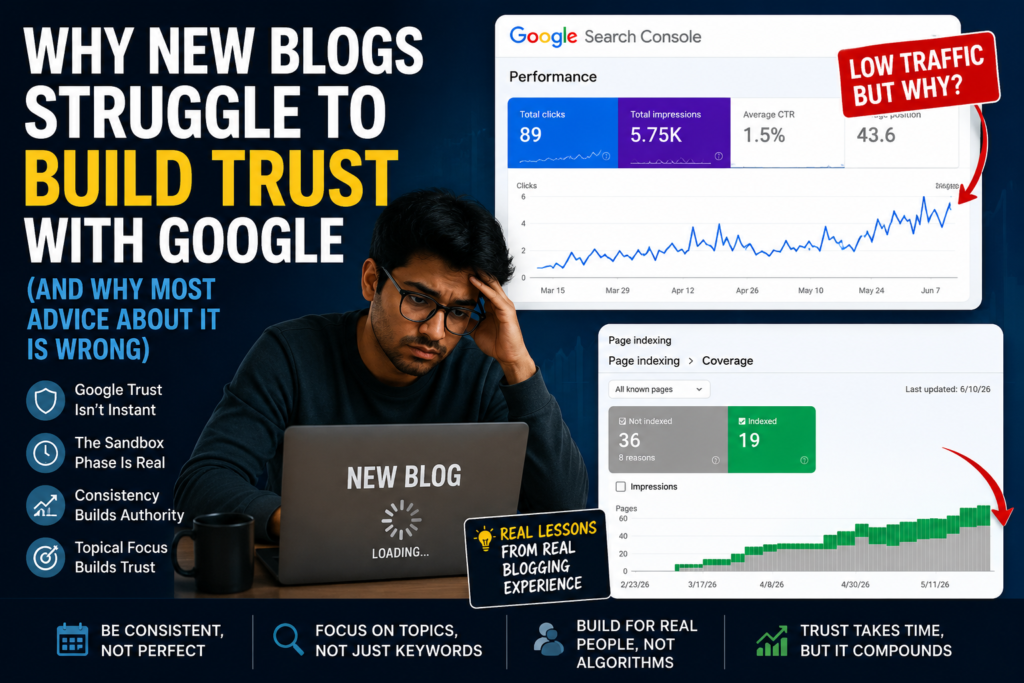
Why New Blogs Struggle to Build Trust With Google (And Why Most Advice About It Is Wrong)
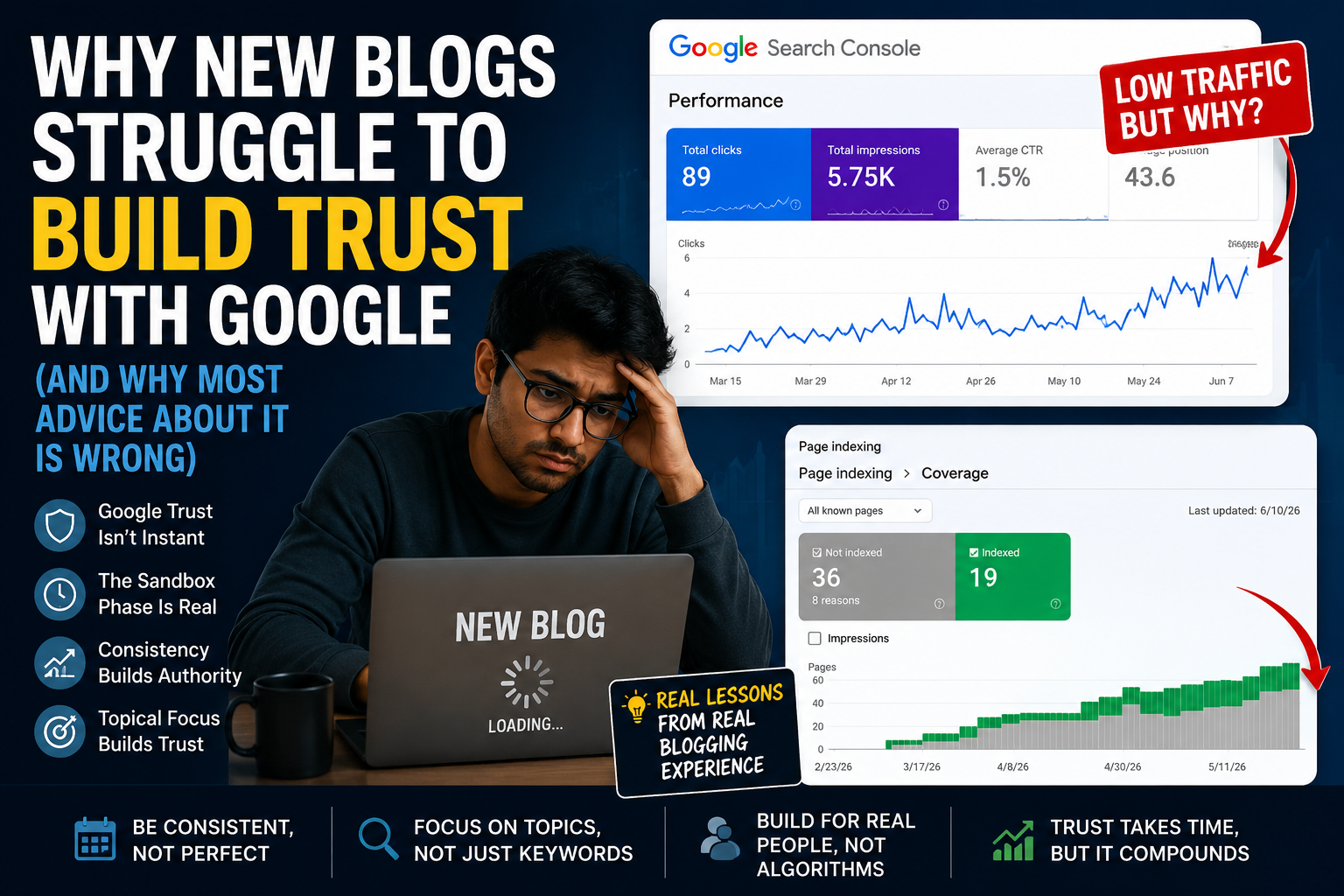
I launched my first blog thinking I’d done everything right. Good niche. Decent keyword research. Consistent publishing schedule. I even bought a premium theme because I read somewhere that design affects bounce rate.
Six months later, Google was sending me roughly eleven visitors a day. On good days.
That’s when I started digging into why new blogs struggle to build trust with Google — not the surface-level “write quality content” version of that conversation, but the actual, messy, humbling reality of it. Turns out the problem isn’t usually content quality. It’s something more structural, and a lot harder to fix with a quick checklist.
What Google Trust Actually Is (and What People Get Wrong About It)
People throw around “domain authority” like it’s a single score Google literally reads and acts on. It’s not. DA is a Moz metric. Google has its own internal understanding of site quality, and it’s built from a dozen different signals — most of which new bloggers aren’t even thinking about.
Real Google trust, as far as anyone can observe from years of testing, is more like: does this site have a consistent track record of producing content that real people actually interact with? Not just does it have backlinks. Not just does it have a sitemap. Does it look — to a machine trained on hundreds of millions of websites — like a site a real person runs, with expertise, consistency, and reader loyalty?
That’s a much harder bar than most SEO tutorials suggest.
The mistake I kept making early on was treating trust as a technical checklist. SSL certificate? Check. Fast load speed? Check. Meta descriptions? Check. Done.
Not done. Not even close. That’s just table stakes. That’s the floor, not the ceiling.
Why Most New Blogs Never Get Past the “Sandbox” Phase
Google has what many SEO practitioners informally call a sandbox effect — a kind of probationary period for new domains where rankings are deliberately suppressed regardless of content quality. Google doesn’t officially confirm this exists. But anyone who’s watched enough new sites grow (or not grow) over the years starts to notice the pattern.
A new blog can publish genuinely excellent content, get a few backlinks, and still sit at position 40–60 for months. Then something shifts — usually around the 6 to 9 month mark — and rankings start climbing without any new changes to the content itself.
What changed? Not the content. The domain aged. Google had time to observe behavior.
That’s uncomfortable to hear if you’re three months into a blog and expecting traction. But it matters, because if you understand this, you stop making the worst mistake new bloggers make: churning out thirty posts in month one, burning out, and then abandoning the blog before the trust actually kicks in.
I did that with my second site. Forty-three posts in eight weeks. Then two months of nothing because I was exhausted. Traffic started moving right around the time I’d mentally given up. Painful. Every time I think about it.
The Consistency Signal Nobody Talks About Enough
Here’s something I noticed after watching several blogs — my own and others I’ve helped — go through the early growth phase.
Google seems to weight publishing consistency heavily. Not just publish frequency, but the regularity of it.
A blog that publishes two posts a week for six months straight looks very different to Google than a blog that publishes twenty posts in month one and then goes quiet. Even if the total post count is similar. Why? Because one of those patterns looks like a real editorial operation. The other looks like a content dump.
I tested this accidentally. My main blog went through a period where I was publishing every Monday and Thursday without fail. Not always my best work — some of those posts were honestly pretty mediocre. Then I got busy, took a six-week break, came back with five really strong posts in two weeks.
The consistent period outperformed the catch-up burst significantly. The strong posts from the burst period took months longer to rank than comparable posts from my consistent phase. Make of that what you will.
Where the Content Strategy Usually Falls Apart
Most new bloggers pick their topics based on keyword volume. I did it. Almost everyone does at first.
The problem is that chasing volume means you’re competing against sites with years of trust already banked. You’re a brand-new restaurant trying to win a Michelin star against places that have been open for a decade. The food might actually be better — doesn’t matter yet.
The smarter early approach, which I wish someone had explained to me plainly, is to go extremely narrow and go deep. Not just “target long-tail keywords.” Go genuinely, uncomfortably specific. Write posts that answer questions so niche that almost nobody else has covered them.
Here’s why this works: Google doesn’t just look at individual posts. It looks at topical clusters. If your site has thirty posts all tightly related to one narrow subject, Google starts to understand that this site is about this specific thing. That builds topical authority, which is one of the legitimate pathways to trust that new blogs can actually access.
When I shifted my strategy from “write about anything in my niche” to “become the most thorough resource on this one corner of the niche,” things started moving. Took about four months to see it clearly. But it worked.
The Backlink Trap (And Why I Wasted Three Months Chasing the Wrong Ones)
New bloggers hear “get backlinks” and immediately start emailing strangers asking for link exchanges or guest posts on DA 12 blogs that haven’t published anything in eight months.
Waste of time. Worse than waste of time — some of those links actively look suspicious.
Google’s guidance here is actually pretty clear, if you read the documentation carefully: links that are editorially given, meaning someone chose to link to you because your content genuinely helped them, carry the most weight. Links you engineered through outreach schemes or reciprocal arrangements carry much less, and links from low-quality sites can pull your trust score down.
The honest truth is that for the first year, most new blogs won’t get many meaningful backlinks no matter what they do. That’s normal. The play during that period is to build content so good and so specific that when people in your space do find it, they link to it without being asked.
I got my first real link from a mid-authority site because I published a post with original data from a small survey I ran on Reddit. Took me a few hours to run the survey and compile the results. That post has three times the backlinks of any other post on the site. Specificity plus original data is a combination almost nobody bothers with early on.
The Author Trust Problem Nobody Warned Me About
This one embarrassed me when I figured it out.
For about eighteen months, I ran my blog with no author bio. No about page beyond a vague paragraph. No indication that a real human with real experience was writing the content.
This was before Google started talking publicly about E-E-A-T — Experience, Expertise, Authoritativeness, Trustworthiness — as a core quality signal. But the concept existed in their Quality Rater Guidelines long before it became mainstream SEO conversation.
What this means practically: Google tries to assess whether the person writing content on a given topic has any credibility to do so. A financial blog run by someone who lists no credentials and has no professional history looks different than one run by someone with a verifiable background in finance. A health blog with an anonymous author raises more flags than one where the author links to their LinkedIn or has bylines elsewhere.
I added a proper author bio, built out the about page, added a few external mentions and bylines on other sites, and within about three months the content I’d written before started performing noticeably better. Correlation, not proof — but consistent with what Google says it values.
New blogs almost universally skip this. It’s boring admin work and it feels like it doesn’t matter. It does.
What Usually Kills New Blogs Before Trust Kicks In
The answer isn’t bad content. It’s impatience combined with bad benchmarks.
New bloggers measure success in weeks when the actual feedback loop operates in months. They see flat traffic at month three and conclude the strategy is broken. They pivot. They start over. They chase whatever worked for someone else on Twitter last week.
Meanwhile, the blogs that grind through the awkward six-to-twelve month trust-building phase — consistently, without dramatically changing strategy — are the ones that suddenly appear to “explode” out of nowhere. They didn’t explode. They just waited out the sandbox while everyone else quit.
The other thing that kills blogs: trying to cover too much. A new blog that writes about productivity, personal finance, travel, and cooking is not building topical authority in anything. It’s signaling confusion. Pick a lane. Go absurdly deep in it. Expand later.
An Honest Takeaway
Building Google trust as a new blog is slow, somewhat opaque, and occasionally maddening. There’s no trick. There’s no tool that shortcuts it. There are some smart strategic moves — narrow topical focus, consistent publishing, author credibility signals, original data — but none of them work fast.
The blogs I’ve seen fail almost all had the same problem: they wanted the results of a twelve-month-old site in month two.
The blogs that made it through were often not the ones with the best content. They were the ones that kept showing up consistently, stayed in a narrow lane long enough to own it, and didn’t panic when the first few months looked like nothing was happening.
Google trust isn’t given. It’s observed over time. And the only way to be observed is to still be there.
Stop optimizing for shortcuts. Start optimizing for staying power.