
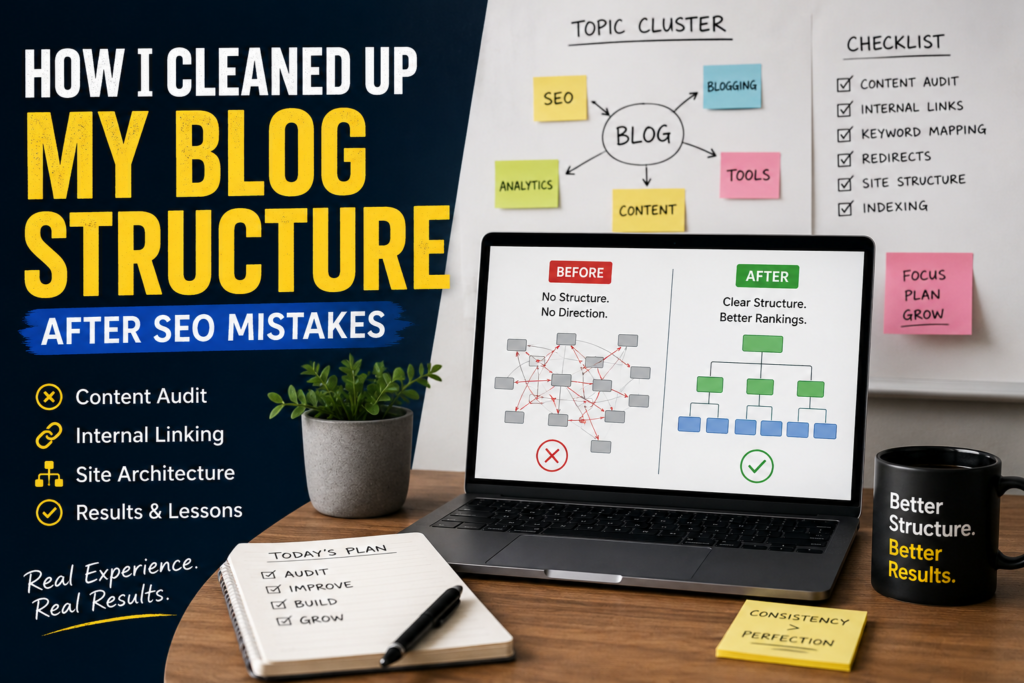
Blog Structure After SEO Mistakes: What Actually Worked
Let me be upfront about something. When I first started taking blog structure after SEO seriously, I genuinely thought I was already doing it right. Organized categories. A clean menu. Posts going up consistently. The whole thing looked fine from the outside. Looked fine isn’t the same as working.
Traffic was flat. Some posts that I’d spent three hours on were getting maybe thirty visits a month. Others with barely any effort were pulling in a few hundred. And I had no idea why the gap existed. That confusion is where most bloggers spend way too long — staring at Analytics data, messing with titles, wondering why the algorithm “hates” them.
Spoiler: it wasn’t the algorithm. It was the structure. It took me an embarrassingly long time to understand that distinction.
What “blog structure” actually means vs. what most people assume
The common assumption is that blog structure is about navigation. Menu items. Category pages. Making it easy for humans to click around. That’s part of it, but only a small part.
Real blog structure — the kind that affects how search engines understand your site — is about three things happening together: topical depth, internal linking logic, and URL/crawl hierarchy. When those three things are misaligned, you get what I had: a blog that publishes regularly but ranks sporadically at best.
I was doing the random publishing thing. Travel tips next to productivity hacks next to a random listicle about coffee subscriptions I’d written during a slow weekend. Each post was fine on its own. Together, they told search engines nothing coherent about what my site was actually about.
Not ideal. Genuinely embarrassing in retrospect.
Why most bloggers get this wrong from the start
Because nobody teaches structure at the beginning. The typical early-blogger journey goes: pick a niche (loosely), install WordPress, write posts about things you’re interested in, wonder why nothing ranks. The technical SEO conversations — site architecture, crawl depth, topic clusters — those come later. Way later. Usually after someone’s already published sixty posts that need restructuring.
There’s also a mindset problem. A lot of bloggers treat each post as a standalone piece of content. You write it, you publish it, you move on. That’s a newspaper mindset, not a website mindset. A website is a living structure. Posts should connect to each other, reinforce each other, and build a coherent topical story over time.
I spent about fourteen months treating my blog like a newspaper. Published seventy-two posts. Realized I had a content pile, not a content architecture. The cleanup that followed was genuinely painful.
What I actually did to clean up my blog structure after the SEO damage
First thing: a full content audit. Not a quick scan — an actual spreadsheet. Every post, its URL, its traffic over the past twelve months, its word count, its primary keyword, and whether it had any internal links going to or from it. That took about two full days.
What I found was predictable once I saw it. About forty percent of my posts had zero internal links pointing to them. Zero. They existed as isolated pages that nobody — human or crawler — would naturally stumble across unless they came from search directly. And since they weren’t ranking, they effectively didn’t exist.
Big mistake. Classic beginner move. Painful to admit.
The second thing I found: I had about eleven posts targeting essentially the same keyword cluster. Not intentionally. Just organically over time, I’d written variations of the same topic without realizing. They were competing with each other. That’s called keyword cannibalization, and it genuinely confuses search engines about which page to rank. Google doesn’t always pick the strongest one. Sometimes it picks the weakest one, or rotates between them, or ranks none of them well. Mine was doing the last option mostly.
The restructuring process — messier than any tutorial will tell you
Step one was consolidating cannibalizing posts. I had four posts about email newsletter strategy. I picked the strongest one — highest traffic, most backlinks, best structure — and merged the useful information from the others into it. Then I set 301 redirects from the old URLs to the new one.
This sounds clean in theory. In practice, it took me three attempts. First attempt, I forgot to update internal links pointing to the old URLs. So the redirects worked, but I had dozens of internal links going to pages that then bounced users to the consolidated post. Not a disaster, but not elegant either. Wasted a weekend fixing that.
Second thing I did was build topic clusters deliberately. I picked four core topics that actually reflected what my blog was genuinely good at — the areas where I had real depth and had written the most. Then I mapped which existing posts belonged to each cluster, which needed to be written to fill gaps, and which needed to be either merged or deleted entirely.
Deleting content is emotionally hard when you spent four hours writing it. I get it. But a weak post dragging down your average content quality is a worse long-term trade than the discomfort of removing it. I ended up deleting or noindexing about eighteen posts. Traffic went up the following month. Correlation isn’t causation, but it wasn’t a coincidence either.
Internal linking — where blog structure after SEO actually gets interesting
Internal linking is probably the most undervalued structural tool bloggers have. Not in a vague, “add more internal links” way — that advice is useless. I mean building deliberate pathways through your content that help both readers and crawlers understand the hierarchy of your topics.
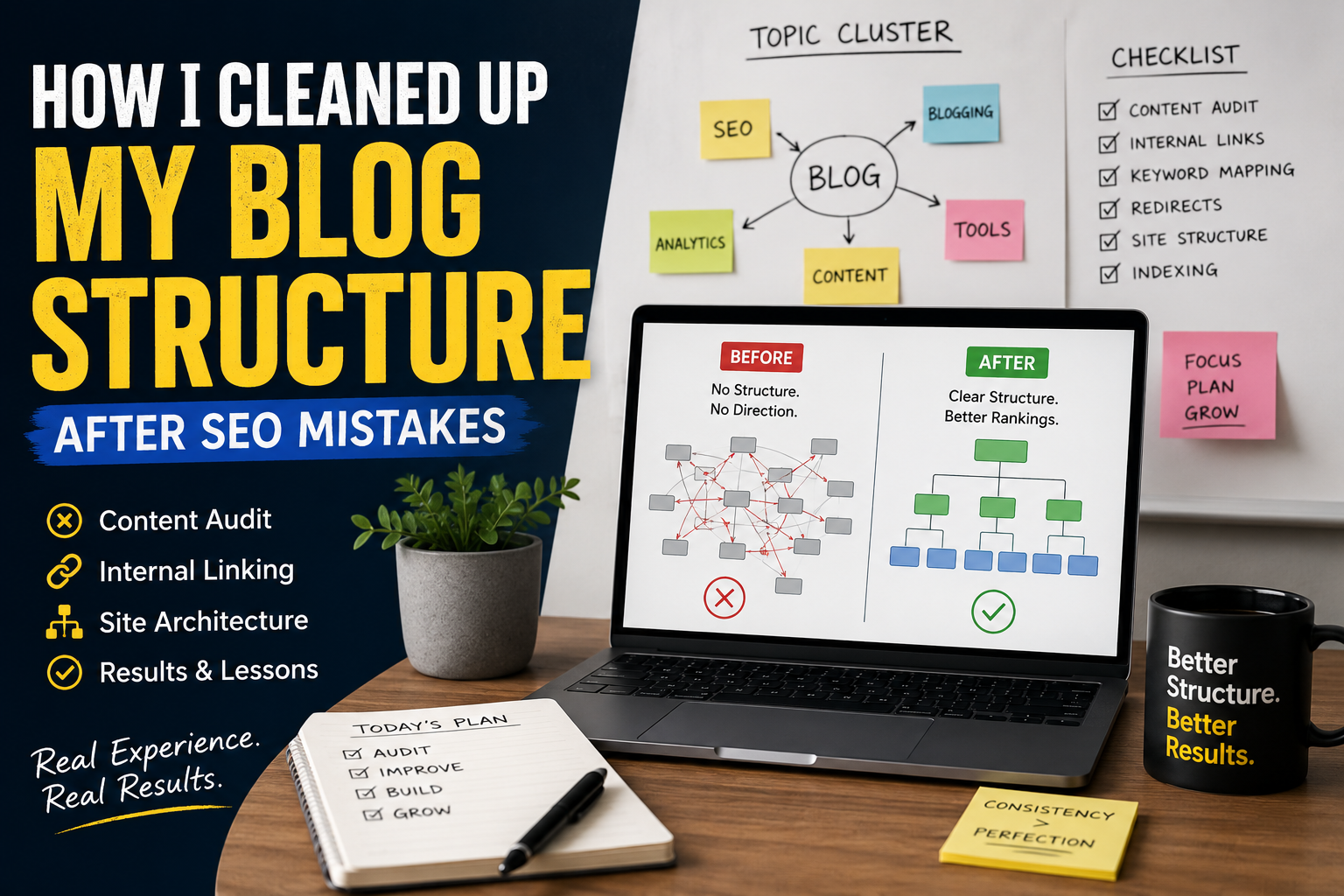
The way I rebuilt my internal linking was simple but tedious. For each cluster, I defined one pillar post — the most comprehensive, authoritative piece on that topic. Then every other post in the cluster needed to link back to the pillar, and the pillar needed to link out to the supporting posts. That creates a hub-and-spoke structure that Google can actually parse.
The specific detail that most tutorials gloss over: anchor text matters, but not in the over-optimized way that got people penalized years ago. Natural, descriptive anchor text — the kind that tells a reader exactly what they’ll find if they click — is what you want. “Click here” is dead. “My full breakdown of email list segmentation strategy” is much better. Slightly more words, but it signals relevance to both the reader and the crawler.
Where this usually falls apart — the honest list
Consistency. You restructure everything carefully, build your clusters, fix your internal links — and then you go back to publishing randomly because you have an idea and you just want to write it. Three months later you’ve added sixteen new posts and only six of them fit neatly into your cluster structure. The other ten are orphaned again.
I’ve done this. Twice. You build the system, then you erode it slowly with casual publishing decisions. The fix is boring: before you write a new post, decide which cluster it belongs to. If it doesn’t belong to any of your clusters, ask whether you should expand a cluster or skip the post. That ten-second decision saves you weeks of future cleanup.
The second place it falls apart: URL structure. I had posts with dates in the URLs from an early WordPress setting I never changed. Something like /2021/03/07/email-strategy-guide/. Dates in URLs aren’t inherently catastrophic, but they age content unnecessarily and add crawl depth. Fixing URL structure means redirects. Redirects done wrong mean broken links. Broken links mean lost link equity. I changed URL structures once and spent two weeks sorting out the redirect chain mess. Not fun.
Third problem: confusing page speed improvements with structural improvements. They’re related but not the same. A fast-loading site with terrible structure still has terrible structure. I wasted about a month obsessing over Core Web Vitals when my actual problem was topical incoherence. Fix structure first. Then optimize speed.
What actually moved the needle — the unglamorous truth
Three things made a measurable difference in the months after restructuring:
One: merging cannibalizing content. The consolidated posts started ranking higher than any of the individual posts had managed separately. Makes sense in retrospect — one strong page beats four mediocre ones competing with each other.
Two: building the pillar posts from scratch where I had cluster topics but no clear authority piece. One of my clusters had eight supporting posts and no pillar. I wrote a 3,400-word pillar, linked everything to it, and within ten weeks it was pulling more traffic than the eight supporting posts combined. That ratio surprised me.
Three: deleting thin content. I will say this again because I resisted it for so long: removing posts that add nothing is not losing work, it’s cleaning up noise. The overall quality signal of the site matters. A bunch of weak, low-traffic pages are an anchor, not neutral.
One mistake I’d warn anyone about specifically

Don’t restructure and then immediately check rankings every two days. The post-restructuring period is genuinely volatile. I restructured in October, panicked by November when some posts had dropped, then by January things had mostly recovered and improved. The volatility after major structural changes is normal. Search engines are re-evaluating your site. That takes time. The bloggers who panic and undo their changes during the dip are the ones who get no benefit.
I almost did this. Nearly reverted the whole thing after week three. Didn’t. Glad I didn’t.
Blog structure after SEO isn’t a one-time fix. It’s a discipline — the boring kind that compounds over time while everyone else is chasing content volume. The sites that grow consistently aren’t the ones publishing the most. They’re the ones that built something coherent and kept it that way. Start there.
Explore more here: Hova Blogs
Join us on YouTube
We also share step-by-step blogging videos, SEO walkthroughs, and content growth strategies on our YouTube channel if you prefer watching instead of reading.
Watch here: HovaBlog YouTube Channel