
Why Is My Blog Ranking But Getting No Clicks — And Why I Ignored the Real Answer for Months
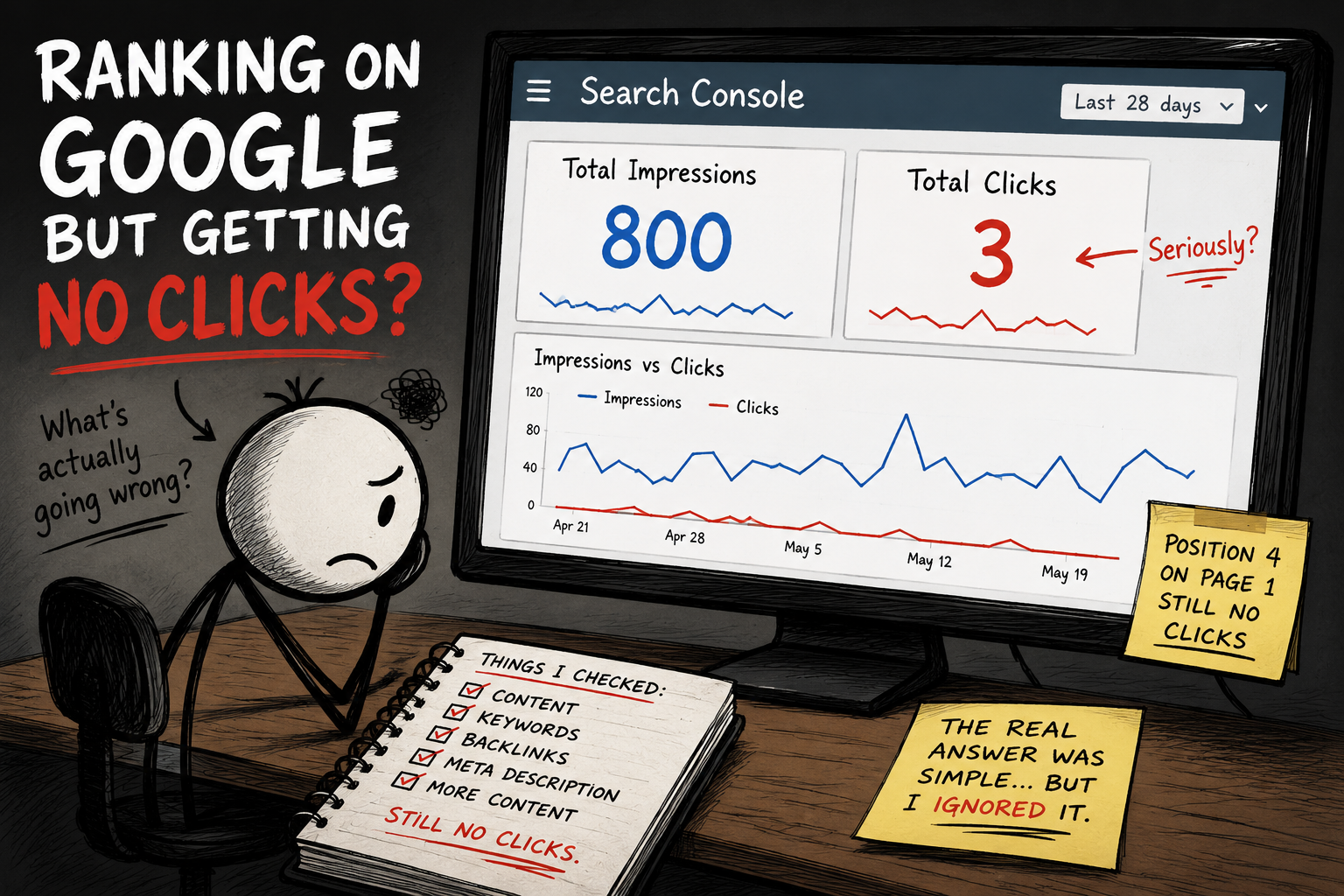
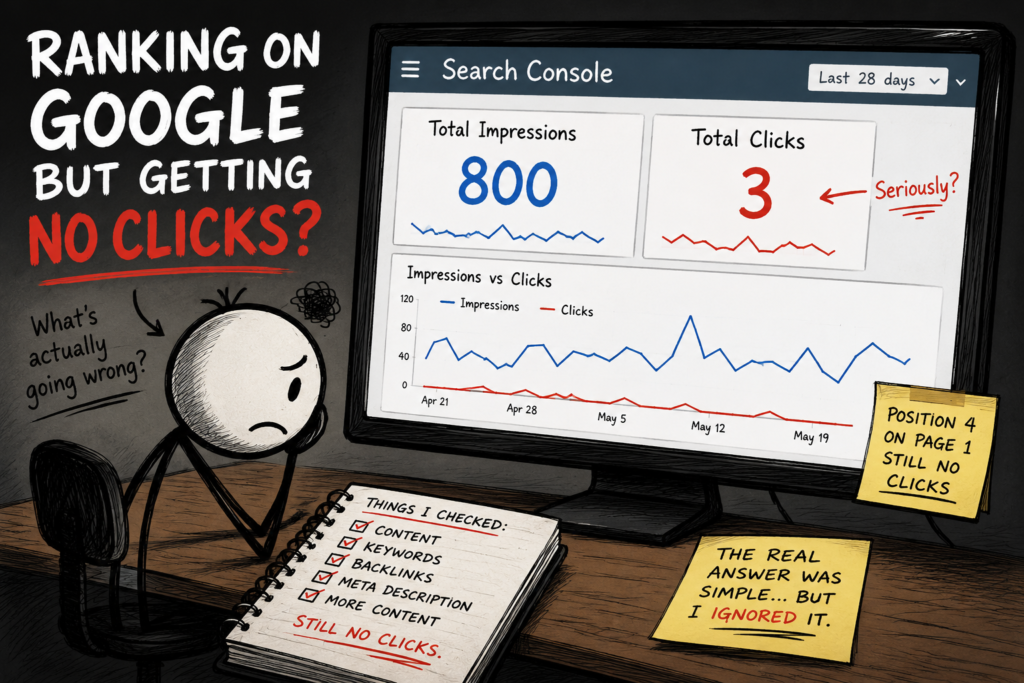
There’s a specific kind of frustration that comes from ranking on page one and getting nothing from it.
Not the frustration of not ranking. That one at least makes sense. This one is worse — because you did the work, you got the position, and Google still isn’t sending you anyone. You start questioning whether SEO is broken, whether your niche is dead, whether you should have just started a YouTube channel instead.
I’ve been there. Multiple times. Different sites, different niches, same pattern. My blog ranking but getting no clicks became almost a recurring theme for me before I actually started paying attention to the right things.
The hard part isn’t finding explanations. Everyone has a list. Title tags. Meta descriptions. Search intent. SERP features. You can read twelve different articles on this and come away with twelve different checklists that all sound reasonable and none of which actually help you figure out what’s wrong with your specific post.
What I’m going to write here is what I actually learned — not from reading about it, but from watching it happen to my own content repeatedly.
The Moment I Realized I Was Measuring the Wrong Thing
For a long time, I treated ranking position as the finish line. Get the post to page one, job done, traffic follows. That’s the mental model most people start with. It’s also completely wrong, and nobody really corrects it until you’ve already wasted months publishing content that gets impressions and nothing else.
I had a post — a fairly long one, something I actually spent real time on — sitting at position 4 for a keyword that a tool told me had around 900 monthly searches. I checked it every few days. The impressions climbed slowly. The clicks stayed at basically zero.
For two months I told myself it needed more time. More time is sometimes the right answer. In this case it wasn’t.
What I eventually found when I actually looked at the SERP properly: the top three results were all from massive authority sites. One was a Reddit thread with 400 comments. One was from a site with a domain rating I couldn’t compete with in a decade. And position one had a featured snippet that answered the exact question someone would be searching for — completely, in four sentences, without requiring a click.
I was ranking fourth below content that was functionally impossible to displace, under a featured snippet that gave people everything they needed before they even considered clicking anything else.
So yeah. Position 4 sounds close. In that particular context, it was worthless.
That was a painful thing to accept about a post I’d actually put effort into.
Why “Why Is My Blog Ranking But Getting No Clicks” Is Actually Several Different Problems
I want to be specific here because this is where most explanations fall apart. They treat the symptom as one problem when it’s actually a cluster of completely different problems that look identical in Search Console.
Problem one: your position is real but your effective position is not.
Featured snippets, People Also Ask boxes, Google Shopping results, map packs, video carousels — all of these appear before organic results. If any of them are present for your keyword, your “position 3” is physically lower on the page than it sounds. On mobile, which is where most searches happen, you might be below the fold entirely. Nobody scrolls down there unless they’re already pretty determined.
I tested this with my own phone once. Searched for a keyword I was ranking for. Had to scroll through a featured snippet, two PAA boxes, and a “related searches” section before I even got to organic results. I was position 2. My result was the seventh piece of content a person would have to scroll past. That’s not position 2 in any meaningful sense.
Problem two: your title is technically correct but emotionally invisible.
This one took me embarrassingly long to understand. I was writing titles that were accurate and keyword-optimized and completely forgettable. No tension. No specificity. No reason to choose mine over the one next to it.
The titles I wrote early on read like topic labels, not reasons to click. “How to Build an Email List” is a topic label. “I Built My Email List to 4,000 Subscribers Without Social Media — Here’s What Actually Worked” is a reason to click. Same topic. Wildly different CTR.
I’m not saying every title needs to be a case study. But there has to be something that signals why this particular result is worth opening. If your title could be swapped with any of the other results on the page without anyone noticing, that’s a problem.
Problem three: the keyword volume was never real.
This is the one nobody wants to say out loud. Keyword tools are estimates. Sometimes they’re reasonably accurate. Sometimes they’re completely off in ways that only become obvious once you’re ranking and watching the impressions trickle in.
I’ve ranked position 1 for keywords that tools reported at 600 monthly searches. Actual clicks over a full month: 14. The searches just weren’t there in the volume the tool suggested. Could be seasonality. Could be the tool pulling outdated data. Could be the query being something people think once and never search again.
Painful to realize after the fact. Even more painful when you’ve built a content strategy around several of these keywords at once.
What I Actually Changed That Made a Difference
I want to be honest: there’s no single fix. Anyone telling you otherwise is selling something.
But when I started genuinely improving CTR on underperforming posts, the changes that moved the needle were almost always title rewrites. Not meta descriptions, not schema markup, not adding more content to the article. The title.
Here’s my rough process. I open Search Console and filter by pages with high impressions and low clicks — specifically anything with a CTR below 2% that’s been sitting there for at least sixty days. That threshold matters. Newer posts fluctuate wildly and you’ll chase ghosts if you touch them too early.
Then I look at what queries are actually driving those impressions. Not what I thought I was targeting — what people are actually searching when Google decides to show my page. Often these are slightly different from my intended keyword. Sometimes they’re completely different. That gap tells me a lot about whether the post actually addresses what people want or whether I wrote the wrong article entirely.
If the queries make sense but the CTR is still weak, the problem is usually the title. I rewrite it with something more specific, more direct, and with some kind of signal that distinguishes it — a number, an outcome, a counterintuitive angle, something that creates a small moment of “hm, that’s different.”
Then I update the post, submit it in Search Console for re-crawling, and leave it alone for a month. That part is genuinely difficult. The urge to keep tweaking is strong. It doesn’t help. Google needs time to reprocess the change, and Search Console needs another few days after that to reflect accurate data. Checking it every three days after the edit is just self-inflicted anxiety with no useful information.
The Search Intent Problem Nobody Fixes
There’s a version of this problem that title rewrites can’t solve, and it’s worth naming separately: wrong search intent.
Sometimes a post is ranking for queries where the searcher wants something the post doesn’t provide. Not because the post is bad — just because it’s the wrong format or the wrong depth for that particular query.
Someone searching “best project management tools” wants a comparison list. If your post is a philosophical essay about how to think about productivity software, you’re going to rank for adjacent queries and convert none of them into clicks. Because even if they click, they’ll bounce immediately. And if Google’s figured that out from behavioral signals, your CTR will stay low because the result is being surfaced to people it doesn’t actually serve.
I had a post like this. Wrote a long, opinion-driven piece about email marketing. Kept getting impressions for queries like “email marketing software comparison” and “best email marketing tools 2023.” My post wasn’t that. I didn’t have a comparison table. I had opinions about strategy.
I had two options: rewrite the post entirely to match intent, or accept that it was the wrong vehicle for those queries and target different ones. I chose to rewrite it. Added a comparison section, added a table, restructured the intro. CTR improved noticeably within six weeks. The post I originally wrote is basically gone now, replaced by something more useful to the people finding it.
That part annoyed me. I liked the original post better. But the original post wasn’t doing anything.
A Note on Branded SERPs and Low-Competition Keywords
Here’s an honest opinion that will probably irritate some people: chasing low-competition keywords is not automa
tically a smart move.
Everyone says to target low-competition keywords when you’re a newer site. That advice isn’t wrong exactly, but it leads people into targeting queries that either have no real volume, are dominated by zero-click features, or are low competition because nobody is actually searching for them with real intent.
I went through a phase of building out “low competition” content that got impressions and no clicks across the board. Not because my content was weak — some of it was actually pretty solid — but because the queries themselves weren’t driving clickable traffic. They were informational in a way that Google could answer directly, or they were niche enough that the few people searching for them already knew what they were looking for and weren’t going to click on a blog post to find out.
Low competition is only valuable if there’s real, click-worthy intent behind it. A keyword that’s easy to rank for because nobody searches for it is not an opportunity. It’s a dead end dressed up as strategy.
What Search Console Tells You If You Actually Read It
Most people use Search Console to check positions and feel good or bad about them. Fewer people use it to actually diagnose problems.
The thing that changed how I approach this: sorting by CTR ascending and filtering out anything with fewer than 100 impressions. What’s left is a list of pages that are being shown to real people in real numbers and being ignored. That’s your actual problem list.
From there, drilling into each page and looking at the specific queries — not the average position, not the total impressions, but the individual query strings — tells you whether the intent is right, whether the titles are matching what people actually want, and whether you’re showing up for the right version of your keyword.
Takes maybe twenty minutes per post. Most people don’t do it. It’s not glamorous. But it’s the difference between guessing and actually understanding what’s wrong.
One More Thing
Impressions going up while clicks stay flat is not a good trend. I know it feels like momentum. It’s not. It means Google is showing your page to more people who are choosing not to click it. That’s the opposite of momentum.
If you’re seeing that pattern, something about the title, the intent match, or the SERP context is wrong. More time won’t fix it. More backlinks probably won’t fix it. The issue is almost always visible in the data if you look at the right columns.
Figuring out why your blog is ranking but getting no clicks is genuinely solvable. It just requires looking at the actual problem instead of the position number you want to be proud of.
The position number is almost never the problem. Everything around it usually is.
Want to know more about Hova Blogs?
We share practical blogging, SEO, AI content, and workflow guides based on real testing — not recycled advice.
Visit:
https://hovablogs.com/