
How Many Blog Posts Should I Publish Per Week for SEO? The Honest Answer After Testing Both Extremes

I’ve asked myself this question probably forty times over the past three years. Sometimes at the start of a new site when I’m optimistic. Sometimes at 1AM staring at Search Console watching impressions flatline. Sometimes after a Google update wrecked a site I was proud of.
The honest answer is messier than most people want it to be. How many blog posts should I publish per week for SEO isn’t a question with a clean number attached to it. Anyone who gives you a clean number — “three posts a week,” “one high-quality post a week” — is either guessing or selling something.
I tried both extremes on purpose. Here’s what actually happened.
The “Publish Everything” Phase
About two years into running a niche site in the home improvement space, I decided to test volume. I’d read the usual advice about topical authority and content clusters and all that. Made sense on paper.
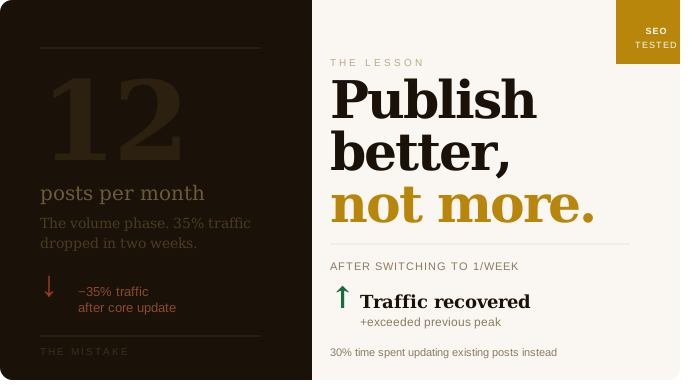
So I went hard. Twelve to fifteen posts a month. Some of them decent. A lot of them honestly pretty thin, padded out to hit a word count that felt respectable. I was using AI to generate drafts and editing them fast. Too fast.
The first three months looked good in Search Console. Impressions went up. I got excited. I started thinking about traffic projections.
Then the impressions stopped converting into clicks. Position 14, position 18, position 11. Just hovering. Pages that should have ranked were getting impressions but terrible CTR, which usually means the title or meta isn’t matching intent well, or the content isn’t satisfying what the searcher actually wanted.
A few months after that, I hit a core update. Lost about 35% of traffic in about two weeks.
The painful part: when I went back and audited what got hit hardest, it was almost entirely the thin posts I’d rushed. The ones I’d published just to keep the cadence going. Google had indexed them, given them a chance, and apparently decided they weren’t good enough to hold their position. Or maybe the site’s overall quality signal dropped because I’d diluted it with mediocre content.
I don’t know which exactly. That’s SEO. You rarely know exactly.
Switching to One Good Post a Week
After that I slowed down hard. One post a week. Sometimes one every ten days. I spent actual time on each one — checking the top ten results before writing, understanding what format actually ranked for that keyword, sometimes interviewing a subreddit thread to see what real confusion looks like among people searching the topic.
Traffic recovered. Not immediately. There’s always a lag with Google, which is its own kind of torture. But over about four months, things started coming back, and then slowly improving beyond where I was before the hit.
Here’s what I noticed though: the single-post-per-week approach comes with its own problems. You publish less, which means you cover less ground. Competitors who are publishing well — not junk, but genuinely solid content at higher frequency — can outpace your topic coverage. There’s a real tradeoff.
The one-post-a-week approach only worked because I was ruthless about which posts I chose to write. I was targeting keywords with actual traffic and real intent. I wasn’t publishing “just to stay consistent” which is advice I’ve always found slightly annoying. Consistency for its own sake doesn’t do anything. Google doesn’t reward you for showing up. It rewards you for being useful.
What Posting Frequency Actually Means for SEO
This is where most of the bad advice comes from, I think.
People treat publishing frequency like it’s a direct ranking signal. It isn’t. Not in that simple sense. Google doesn’t have a setting that says “this site posts three times a week, give it a ranking boost.” That’s not how it works.
What frequency actually affects is how quickly you build topical coverage, how often your pages get crawled, how fast you discover which content resonates, and — honestly — how quickly you produce weak content that eventually drags your average quality down.
The crawl frequency piece is real. Sites that publish consistently tend to get crawled more often, which means new posts get indexed faster. On slower sites I’ve run, posts would sometimes take three or four weeks to appear in Search Console at all. Painful when you’re waiting to see if something will rank.
But faster crawling doesn’t mean better rankings. That distinction matters. Getting indexed fast is just the starting line.
The Real Mistake I See
Most bloggers who ask how often they should post are actually asking the wrong question. They’re thinking about output when they should be thinking about the pipeline behind the output.
If you can write two genuinely good posts a week that match search intent, solve a real problem, don’t feel like a padded AI article, and cover topics you actually have some business covering — two posts a week is fantastic. Do it.
If your “two posts a week” means one solid post and one thing that’s really just a placeholder existing to fill the schedule, then you’d have been better off with one post and spending the remaining time improving an older article that’s getting impressions but no clicks.
That second scenario. That’s what most people are actually doing without realizing it.
I made that mistake for the better part of six months. Publishing to a schedule instead of publishing to a standard. It’s an easy trap when you’re watching competitors produce high volumes of content and assuming they must be doing something right.
What I Actually Do Now
I don’t have a fixed weekly post count. What I have is a content queue with tiers.
New posts only go in the queue if they meet certain conditions: the keyword has measurable search volume — and I became much more skeptical of “easy keywords” after targeting several low-volume terms that looked promising in SEO tools but barely generated real clicks. I wrote about that whole experience here. The search intent also has to be clear to me, I have to have something worth saying that the top ten results don’t already cover well, and I can write it without it feeling like I’m padding.
Beyond that, I spend a meaningful chunk of time — probably 30% of my content effort now — on updating existing posts. Adding to things that rank on page two or three. Improving internal linking. Fixing titles that aren’t getting clicks even with decent positions.
That updating work doesn’t show up in “posts published per week” but it moves the needle more reliably than adding new content for the sake of it.
No one talks about this enough. New posts get all the attention. Updating existing posts is where a lot of the real gains happen once a site has some traction, especially after updates that shuffled things around.
The Honest Opinion Most People Won’t Like
Here it is: for most solo bloggers running niche sites, one high-quality post per week is probably more than enough. Possibly even too much if you’re sacrificing quality to hit it.
The sites I’ve seen succeed long-term — and I mean actually hold their rankings through multiple core updates, not just spike and disappear — tend to be sites where the content feels like it was written by someone who thought carefully about it. Not necessarily formal or polished. But real. Specific. Containing observations that only come from someone who’s actually engaged with the topic.
I know that’s not a satisfying answer because it doesn’t give you a number. But the question “how many blog posts should I publish per week for SEO” is really a proxy for “how do I grow my traffic faster,” and the answer to that is almost never “publish more.”
It’s usually: publish better, update what’s underperforming, and stop treating frequency as a strategy.
One More Thing About Platform Reality
Google doesn’t tell you why your rankings change. They never will. You’re always going to be working from incomplete signals.
What I watch in Search Console now: impressions to click ratio per page, average position trends over 90 days, pages that are getting impressions but no clicks at all — those are usually title/meta problems or intent mismatches, and I ran into this exact problem badly on another site that ranked surprisingly well but barely pulled traffic. Wrote through the whole diagnosis in this post. And whether new posts get indexed within a reasonable window.
If a post gets impressions without clicks for more than two months, I change the title. Sometimes the meta. Sometimes I go back and look at the search results again and realize I’d misread the intent when I wrote it. That happens more than I’d like to admit.
The obsessive checking Search Console thing — I still do it. Slightly less than I used to. But I’ve accepted it as part of the job. Anyone who says they don’t refresh it too often is lying.
Publishing frequency matters less than you think and more than you think, depending on where your site is and what your content quality looks like. That’s the real answer.
Start with less than you think you need. Once you figure out what actually resonates on your specific site with your specific audience, you’ll have a much clearer sense of whether ramping volume is worth it. Most people figure out pretty quickly it isn’t.
Continue Reading on Hova Blogs
- 7 AI Blogging Mistakes That Secretly Kill Your Google Rankings
- How to Start AI Blogging in 2026: Beginner Step-by-Step Guide
- How AI is Changing SEO in 2026 (And What Bloggers Must Do Right Now)
- Best 10-Minute Workflow Tools for Faster Productivity (2026 Guide)