
The Top AI SEO Tools for Bloggers Nobody Talks About Honestly
I published a 2,400-word post eighteen months ago that I was genuinely proud of. Good research. Decent structure. Primary keyword sitting right there in the title like a good little soldier. It parked itself at position 23 for four solid months and barely twitched. I refreshed Search Console so often it became a nervous habit, like checking your phone after sending a text you regret.
That frustration pushed me to seriously test the top AI SEO tools for bloggers that kept coming up in every niche publishing community I was lurking in. Not because I believed the hype — I was skeptical, honestly — but because what I was doing clearly wasn’t cutting it.
Some of what I found was genuinely useful. Some was glorified keyword stuffing in a chatbot costume. And a few tools solved problems I didn’t even know I had. Let me save you the expensive part of that education.
What People Actually Think These Tools Do (And Why That’s the Problem)
Most bloggers assume AI SEO tools are basically content vending machines. You drop in a keyword, you get back a finished post that ranks. That’s not how any of this works.
Google has been consistent about this — helpful, experience-backed content is what gets rewarded, not automated output produced at scale for its own sake. What the good AI tools actually do is cut down the research and gap-analysis work that used to eat your entire morning. They surface what you should cover, how deep to go, and where your draft is structurally thin before you click publish. The thinking still has to be yours. The experience still has to be yours.
Use these tools to replace your thinking, and you’ll end up with content that reads fine and performs terribly.
I know because I did exactly that for six weeks.
Why Most Bloggers Use These Tools Wrong (And I Was One of Them)
We get access to a shiny new tool. First thing we do is ask it to write the whole article. Done in eleven minutes. Published. Crickets.
Big mistake.
The bloggers actually climbing rankings in 2026 are using AI for the unglamorous work: competitor gap analysis, SERP intent mapping, internal link audits, semantic keyword clustering. They’re not using it as a ghostwriter. They’re using it as the research assistant they can’t afford to hire at $4,000 a month.
I published AI-drafted posts with light editing for almost two months. Watched engagement tank. Bounce rate looked like a ski slope. The content read fine — it just had no texture, no specificity, nothing you couldn’t get from the first two Google results. And readers feel that gap even when they can’t name it.
That’s when I completely changed the workflow.
The Tools I’ve Actually Lived With — Not Just Demo’d
Surfer SEO: Still the On-Page Benchmark (Annoyingly)
Everyone talks about Surfer. There’s a reason.
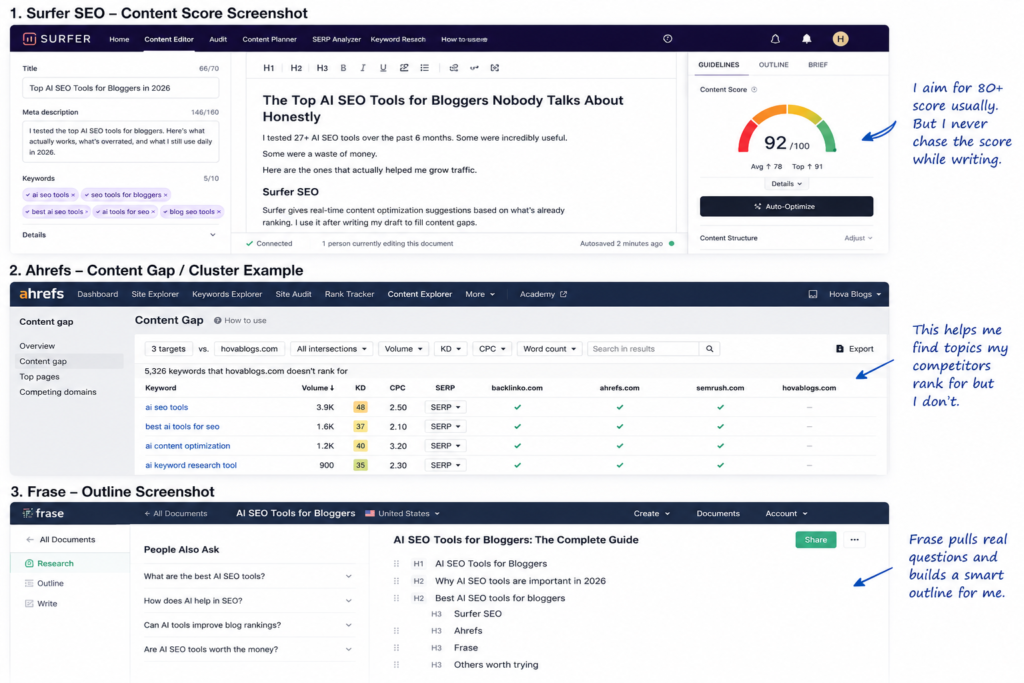
The content editor scores your draft in real-time based on semantic term coverage, word count, heading structure, and entity analysis pulled from pages that are actually ranking. It’s not guessing — it’s looking at what Google is currently rewarding and telling you where you’re falling short.
Here’s the thing though: I use it after I write my first draft. Not during. Not before. After. That order matters more than people realise. If you optimise while you write, you start forcing in terms that sound awkward and clinical. Readers feel the stiffness even if they can’t articulate why the article feels weird.
The thing that mildly infuriates me about Surfer: the score becomes a crutch fast. I’ve seen bloggers hit 94/100 and still rank nowhere, because they gamed the term frequency without actually saying anything useful. A high score is a signal, not a promise. Worth tattooing somewhere visible.
Ahrefs with AI Features: The Research Phase, Honestly Unmatched
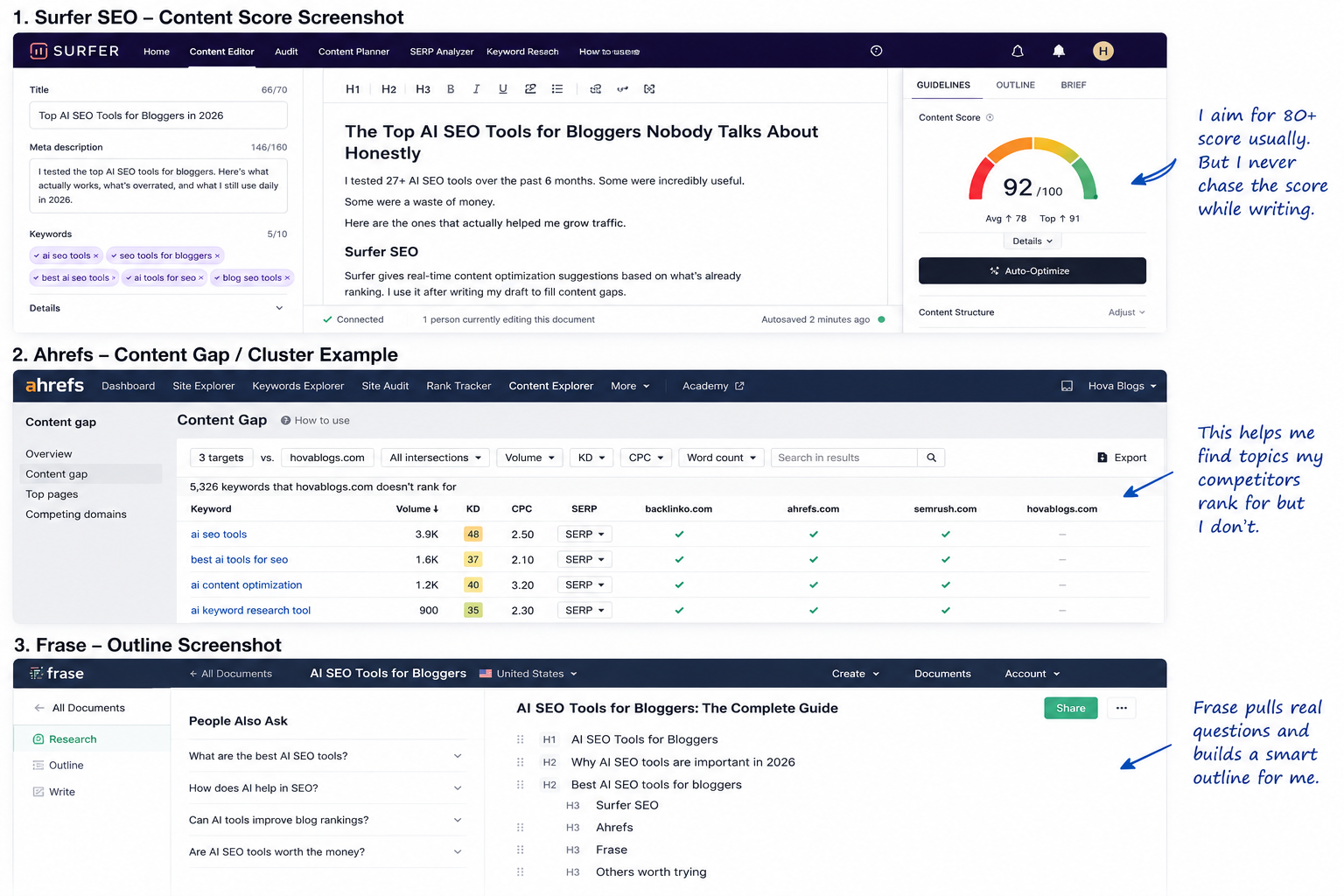
Ahrefs isn’t new. The AI-assisted content gap analysis and cluster-building they’ve added, though — that’s changed how I build topical authority on a new site entirely.
Specific workflow: I export the top 30 ranking URLs for my primary keyword, run them through the content gap tool, then use the AI feature to cluster missing subtopics by search intent. Around forty minutes of work. What comes out is a three-month content calendar that’s internally connected — not a random scatter of keywords with no relationship to each other.
Before this approach, my sites felt like isolated islands. Lots of posts, no internal cohesion. Traffic came in waves and never compounded. Now I build in topic clusters from the start. I’ve watched posts reach page one within six weeks because the supporting content was already indexed and linking in.
Ahrefs is expensive. Not ideal for a single blog running on coffee and optimism. But for multi-site operations, I’ve stopped looking for workarounds. This is just the cost of doing things properly.
Frase.io: Massively Underrated for Brief-Building
Frase doesn’t get enough attention and I don’t fully understand why.
What it does well is pull together the questions real people are actually asking around a topic — People Also Ask data, forum threads, Reddit patterns — and organise them into a working outline. I use it specifically for informational content where reader intent is genuinely fragmented. Someone searching “how to start a food blog” might want the technical setup walkthrough, or they might want monetisation timelines, or both. Frase shows you that split before you’ve written one sentence.
The AI writing suggestions inside Frase? I leave those off. Nearly every time. The research layer is where the real value sits. The writing suggestions feel like they belong to a different, worse product.
ChatGPT with Custom Instructions: Useful in Exactly One Narrow Way
People either over-trust this tool completely or dismiss it entirely as a toy.
The honest answer sits somewhere frustratingly in the middle.
I use ChatGPT — with saved custom instructions that include my brand voice, my content rules, and my target audience profile — for one specific task: generating semantic keyword variations I might have missed, then cross-referencing those against actual search volume data before I use them. That’s it. Not glamorous. Not exciting. Effective in that limited lane.
What I don’t use it for: full drafts, outlines, or anything where I’m clicking accept and moving on.
I learned this the hard way in early 2024. I published a product roundup that was almost entirely AI-drafted. A reader left a comment pointing out that three of the recommendations were either discontinued or factually wrong. Not a great afternoon. The post got quietly edited and I’ve been more careful since.
NeuronWriter: The Cheaper Surfer Alternative That Actually Holds Up
If Surfer’s pricing is a real obstacle, NeuronWriter does most of the same content scoring work for significantly less money. The UI is messier — sometimes painfully so — and the semantic suggestions aren’t quite as refined. But for a solo blogger publishing two or three times a month, it’s more than adequate.
I ran a comparison on a travel blog I manage. Same topic, same target keyword, one post optimised with Surfer, one with NeuronWriter. After three months, both ranked within two positions of each other. Small sample. But it strongly suggests the performance gap between these tools isn’t as dramatic as the price gap implies.
Quick Comparison: Which Tool Does What (And Where Each One Lets You Down)
If you’re scanning this trying to pick one tool to start with, here’s the honest breakdown. No filler ratings, no star systems. Just what each tool is actually good at and where it quietly disappoints you.
| Tool | Best For | Pricing Feel | Real Weakness | CTR/Readability Impact |
|---|---|---|---|---|
| Surfer SEO | On-page optimization, post-draft scoring | Expensive | Score becomes a crutch; high score ≠ ranking | High — structured content scores better in SERPs |
| Ahrefs + AI | Keyword research, content gap, topic clustering | Very expensive | Overkill for single blogs | High — cluster-based strategy lifts multiple pages |
| Frase.io | Brief building, reader intent mapping | Reasonable | AI writer is weak, leave it off | Medium — better briefs = tighter structure = lower bounce |
| ChatGPT (custom) | Semantic keyword expansion, brainstorming | Low | Hallucinations, no real-time data | Low direct, medium indirect via smarter keyword use |
| NeuronWriter | Budget on-page scoring, solo bloggers | Affordable | Messier UI, slightly less refined suggestions | Medium — comparable to Surfer in real-world rank tests |
A few things worth noting about that table.
The CTR and readability column matters more than most people realise. Better-structured content — tighter subheadings, logical flow, answers placed where readers expect them — directly affects whether someone clicks through from the SERP and whether they stay once they land. Surfer and Ahrefs both push you toward structure that improves those signals, even if neither tool frames it that way explicitly.
Frase improves readability in a different way: it helps you understand what the reader actually wants to know, which means fewer mismatched expectations. Someone lands on your post and finds answers to the exact questions they had. Bounce rate drops. Time on page goes up. That’s the mechanism — not magic, just intent alignment.
NeuronWriter is underrated specifically on the readability side. Its content grading penalises overly dense paragraphs and rewards clear heading hierarchies, which is good discipline if you’re a blogger who tends to write in walls of text. I am that blogger. It helped.
Where This Actually Falls Apart in Practice
Consistency. That’s the honest answer.
The bloggers I’ve watched fail with AI SEO tools are the ones who use them for two posts, see no immediate results, and abandon ship. SEO is a compounding game. A tool that helps you build better topical clusters won’t move your traffic in week one. It shows up six months later when you notice three posts are suddenly ranking simultaneously for related queries that you never even directly targeted.
The other failure point — and this one is sneaky — is treating AI tool output as final. Every recommendation needs a human sanity check. I’ve had Surfer recommend using a specific term eleven times. Sounded robotic by the third appearance. I’ve had Frase pull in PAA questions that had nothing to do with my actual audience’s situation. The tools surface patterns. You apply judgment. Both halves are required.
Painful. Every time you skip the judgment part, it shows up in the content, and eventually in the rankings.
One more thing that almost never gets discussed: AI SEO tools cannot fix thin source material. If your real experience with a topic is shallow, no tool compensates for that. I’ve tested this directly, intentionally, with matched posts. Articles where I had genuine first-hand experience with the subject — where I had specific numbers, specific mistakes, specific observations — outperformed research-only posts across every measured metric, even when the research posts scored higher on optimisation tools.
That’s not a small gap. That’s a consistent, uncomfortable pattern I’ve had to sit with.
The Stack I’d Actually Recommend If You’re Starting Over
If I were rebuilding from zero with a limited budget and wanted to use the top AI SEO tools for bloggers without wasting six months and several hundred dollars learning the wrong lessons:
Start with one keyword and gap analysis tool. Ahrefs or Semrush. Pick one and commit. Use the AI-assisted clustering to map a real content plan before you publish anything. Don’t improvise your way into a topic calendar.
Add one on-page optimisation tool. Frase or NeuronWriter. Try both on free trials and see which UI you can actually tolerate long-term. Both are fine. Neither is magic.
Use ChatGPT with custom instructions for semantic expansion only. Not for drafting. Not for replacing thinking.
Don’t buy everything at once. I subscribed to four overlapping tools in 2024 trying to find the combination that would accelerate everything. Spent over $400 in monthly subscriptions. Looks fine on paper. Wasn’t moving anything faster than a focused two-tool setup would have. Took four months to admit that.
The Honest Takeaway on AI SEO Tools for Bloggers
These tools are useful the same way a good map is useful on a road trip. They show you where the roads are. They don’t drive the car. They won’t stop you from taking a wrong turn if you’re not paying attention, and they definitely won’t make the destination worth arriving at.
The bloggers ranking faster right now aren’t the ones with the most tools or the most expensive subscriptions. They’re the ones who built real topical authority, publish with consistency, and use AI tools to reduce friction in the workflow rather than to shortcut the actual thinking.
Use them that way, and they’re genuinely worth the investment. Use them as a content factory, and you’ll be staring at a flat traffic graph six months from now wondering where it went wrong.
The posts that have held my top three rankings for over a year? Almost all of them were written when I had something real to say. The AI tools helped me say it more strategically.
Nothing more than that. Nothing less.
That’s the whole job, really.
🌐 Explore More:
https://hovablogs.com/