
How Top Bloggers Use AI Blogging Strategy to Outrank Competitors in 2026
You spend hours writing a blog post. You research the topic, fix the formatting, hit publish, and then wait. And wait. And then check Google Analytics to find… zero traffic. Not even close.
Meanwhile, some blogger you have never heard of is sitting on page one of Google for the exact same topic. Their post is not even that much better than yours. So what is going on?
Turns out, a lot of it comes down to one thing: their AI Blogging Strategy . Top bloggers in 2026 are not just writing faster with AI. They are using it smarter, at every single stage of the process, in ways most beginners have never considered.
This post breaks down exactly how bloggers use AI to rank higher, step by step, in plain English, with zero fluff.
What Is an AI Blogging Strategy (and Why Does It Help You Rank)?
An AI blogging strategy is a method of using AI tools to research, write, optimize, and update blog content to rank higher on search engines. It is not about replacing the writer. It is about making every part of the blogging process faster, smarter, and more targeted.
The ranking part is where most people miss the point. A solid AI Blogging Strategy is not just about producing content quickly. It is a full system: finding the right keywords, studying what already ranks, structuring posts the way Google likes, and keeping that content fresh over time. Tools like ChatGPT help with drafting and brainstorming, while platforms like Semrush and Ahrefs give you the keyword data to back your decisions.
Think of it this way. Imagine you and your friend are both opening a coffee shop on the same street. You both make good coffee. But your friend studies what customers actually want, tracks which drinks sell best, and adjusts the menu every few weeks. You just wing it and hope for the best.
That is exactly the difference between casual bloggers and the ones dominating search results right now with a proper AI SEO blogging system.
Why AI Blogging Strategy Actually Matters in 2026
Google has changed a lot over the last few years. It is smarter, faster, and much better at figuring out whether content is genuinely helpful or just stuffed with keywords.
That means old tricks, like keyword stuffing or publishing thin articles, just do not work anymore. Google wants content that answers real questions, that is up to date, and that comes from a source people trust.
This is where AI, when used properly, becomes a serious advantage for anyone who wants to rank a blog with AI tools.
Top bloggers are using AI to:
- Find gaps in what competitors have already covered
- Understand what readers actually want to know
- Write content that is thorough and genuinely useful
- Update old posts before they lose their rankings
- Build internal links that keep readers on their site
The bloggers who ignore this shift are slowly losing ground to the ones who have figured it out.
How Top Bloggers Use AI to Rank Higher: 7 Real Steps
Step 1: They Start with Smarter Keyword Research (This Is Where AI Blogging Strategy)
Most bloggers use keyword tools and call it a day. The smart ones go further.
They feed a topic into an AI tool like ChatGPT and ask it to generate a list of questions real people might type into Google. Then they cross-reference those with actual search data from tools like Ahrefs or Semrush to find ones with decent traffic but low competition.
For example, instead of targeting “best protein powder” and competing with massive fitness sites, a blogger might target “best protein powder for women over 40 who hate chalky taste.” That is a specific question. Less competition. Easier to rank. If you are new to this process, check out our beginner’s guide to SEO basics to understand how keyword difficulty works before diving in.
This is a core part of any AI blogging strategy that actually works. AI makes the research process faster and surfaces angle ideas that a human might not think of right away.
Step 2: They Study What Is Already Ranking Before Writing a Word
Before writing anything, the best bloggers look at what is already ranking on page one. They use AI to summarize those articles and find what is missing.
Maybe every article on page one covers the basics but nobody has explained what happens when things go wrong. Nobody has added a simple checklist at the end. Nobody has addressed a beginner’s real confusion about the topic.
That gap is the opportunity.
AI can scan through multiple articles quickly and highlight what they share in common and where they fall short. The blogger then writes something that covers all the same ground but fills the missing piece. This is one of the clearest ways that bloggers use AI to rank over stronger, older sites.
Step 3: They Use AI to Build a Proper Content Structure
Good structure is one of the most underrated parts of ranking well. A post that is well-organized is easier to read, and Google can understand what it is about more clearly.
Top bloggers use AI to build out a proper outline before they start writing. They tell the AI who their reader is, what the main keyword is, and what tone they want. The AI helps them figure out what headings to use, what order makes sense, and what questions to answer in each section.
This is like having an experienced editor help you plan before you write, not after. It is a simple part of an AI SEO blogging workflow that most beginners skip entirely.
Step 4: They Write with AI but Edit Like a Human
Here is where a lot of beginners go wrong. They generate content with AI and publish it without a second look. The result often sounds robotic, vague, or just plain boring.
The bloggers who rank well treat AI as a first draft machine, not a finished product machine.
They take the draft, rewrite the opening to sound like themselves, add specific examples from their own experience, cut out the fluff, and make it feel like something a real person actually wrote. Because Google can detect low-effort AI content, and more importantly, readers can too. If you want a full breakdown of which AI tools work best for this, see our list of the best AI tools for bloggers in 2026.
One blogger in the personal finance space described it this way: she uses AI to cover the technical parts she might rush through, and then she adds her own story of making the same financial mistake the article is about. That personal layer is what makes readers trust her and come back. That balance is what a real AI blogging strategy looks like in practice.
Step 5: They Optimize to Rank a Blog with AI-Targeted Snippets
In 2026, Google’s AI Overviews appear at the top of many search results. These pull short, clear answers from pages that are well-structured and directly address common questions.
Top bloggers write specific sections of their posts to capture these spots. They include a short, clean definition at the beginning of key sections. They use numbered lists and bullet points where it makes sense. They answer the exact question in the first sentence of a paragraph, then expand below.
Knowing how to rank a blog with AI tools means thinking beyond traditional blue links. These bloggers are aiming to be the answer that appears before page one even starts.
Step 6: They Refresh Old Content Regularly with AI Help
This one surprises a lot of beginners. Publishing new content is important, but updating old content can be just as powerful.
A post that ranked well two years ago might be slipping now because information has changed, competitors have published better versions, or Google’s expectations have shifted.
Top bloggers use AI to audit their older posts. They ask AI tools to compare their article to what is currently ranking and tell them what is outdated, what is missing, and what could be expanded. Then they update and republish.
Google notices fresh updates, and a well-maintained old post can climb back up and hold its position for years. This content refresh cycle is a key part of a long-term AI blogging strategy that most beginners completely overlook.
Step 7: They Build Smart Internal Links Using AI
Internal links, which are links from one post on your site to another, help Google understand how your content is connected. They also keep readers clicking around your site longer, which signals that your content is worth reading.
Top bloggers use AI to find the best internal linking opportunities. They paste in a new post and ask AI to suggest which older posts on their site it should link to and why. They also ask for anchor text suggestions that sound natural rather than forced.
This builds what SEOs call a content cluster, where a group of related posts all support each other and signal to Google that the site is authoritative on a topic. It is a quiet but powerful part of any AI SEO blogging system. For a step-by-step walkthrough, read our complete guide to internal linking for bloggers.
Best Practices for Your AI Blogging Strategy
Do not skip the human layer. AI can generate ideas, outlines, and drafts. But your personal experience, real examples, and genuine voice are what make your content stand out from thousands of other AI-generated posts.
Focus on one topic cluster at a time. Instead of writing random posts on random subjects, pick one main topic and write ten to fifteen interconnected posts around it. This builds topical authority much faster and is one of the smartest moves in any AI blogging strategy.
Use AI to understand your reader, not just fill a word count. Ask AI to describe your ideal reader’s biggest frustrations, their beginner questions, their doubts. Write for that specific person.
Keep your writing simple. Short sentences. Short paragraphs. No jargon unless your audience already knows it. Knowing how bloggers use AI well means using it to simplify complex ideas, not to make them sound smarter.
Track what is actually working. Use Google Search Console to see which of your posts are getting impressions and clicks. Feed that data back into your AI blogging strategy regularly.
Common Mistakes That Kill Your AI SEO Blogging Results
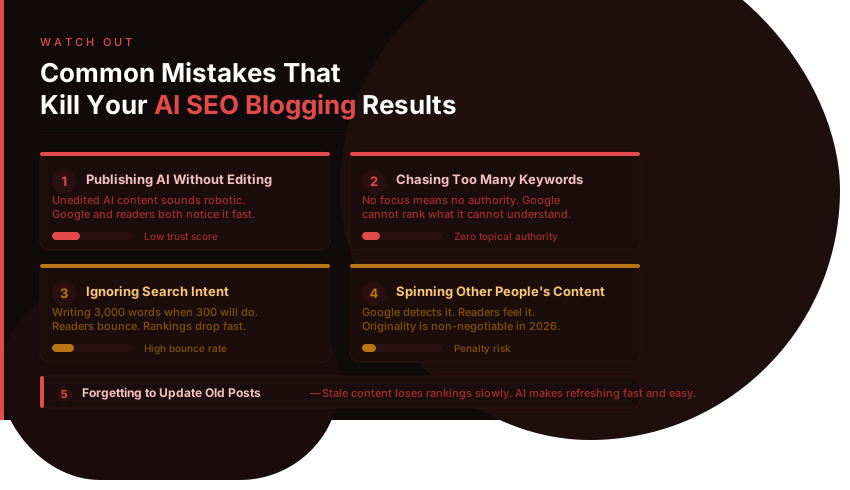
Publishing AI content without editing it. This is the fastest way to build a blog that gets ignored by both readers and Google. Always rewrite and add your voice.
Chasing too many keywords at once. Beginners often try to rank for hundreds of keywords at the same time. The result is a blog with no clear focus and no authority. Pick a lane and go deep. This applies to every AI blogging strategy, no matter how advanced.
Ignoring search intent. Not every keyword deserves a long blog post. Sometimes the reader just wants a quick answer. If you write 3,000 words when 300 would do, people will leave immediately. AI can help you identify what format a reader is actually looking for.
Using AI to spin or rewrite other people’s content. This is both unethical and ineffective. Google is good at identifying this. Write original content. Use AI to help you think, not to copy.
Forgetting to update old posts. The bloggers who treat their archive like a neglected basement are slowly losing the rankings they worked hard to build. A healthy blog maintains what it has built, and AI makes that maintenance process much faster.
Key Takeaways
- An AI blogging strategy is about smarter workflows, not just faster writing
- Keyword research combined with content gap analysis is your biggest ranking advantage
- Tools like ChatGPT, Semrush, and Ahrefs work best when used together as a system
- Human editing is still essential — AI drafts, you refine
- Updating old posts regularly is just as powerful as publishing new ones
- Internal linking builds long-term topical authority that compounds over time
- Optimizing for Google’s AI Overviews and featured snippets puts you ahead of page one
Wrapping Up
The gap between bloggers who are growing and those who are stuck is not talent. It is mostly strategy and consistency.
The AI blogging strategy that top bloggers use in 2026 is not magic. It is research, structure, good writing, and regular maintenance, all done faster and smarter with the help of AI tools. Understanding how bloggers use AI to rank, really use it, not just generate and publish, is what separates the ones climbing from the ones standing still.
Start with one thing from this post. Pick one old article and improve it with AI. Try building a proper outline before your next post. Study what the top-ranking pages are missing before you write.
You do not have to do everything at once. You just have to start.
Frequently Asked Questions
Can AI help rank a blog in 2026?
Yes, absolutely. AI helps with research, content creation, keyword targeting, and optimization. But human editing is still essential. The bloggers who rank are the ones who combine AI speed with real human insight, not the ones who just copy-paste whatever AI generates.
Is AI-written content allowed by Google?
Yes. Google does not penalize content just because AI helped write it. What Google penalizes is content that is unhelpful, thin, or clearly written for search engines instead of real people. If your AI-assisted content is original, useful, and edited properly, it can rank just as well as fully human-written content, sometimes better.
What AI tools do bloggers use for SEO?
The most commonly used tools include ChatGPT and Claude for drafting and brainstorming, Surfer SEO and Clearscope for on-page optimization, and Semrush or Ahrefs for keyword research. Most top bloggers use a combination rather than relying on just one.
How long does it take to rank a blog with AI?
There is no fixed timeline. A well-optimized post on a low-competition keyword can rank in a few weeks. Competitive topics can take three to six months or longer. AI speeds up the content production side, but patience and consistency are still part of the equation.
Ready to put this into action? Pick one post from your blog right now, run it through ChatGPT or Semrush, find what is missing, and improve it today. That single step is where your AI blogging ranking strategy actually begins.