
Why AI Blog Posts Never Get Traffic (Even When Google Indexes Them)

Meta description: Why AI blog posts never get traffic — even after getting indexed — comes down to one thing: thin thinking. Here’s what I found after testing this the hard way.
I’ve watched this happen so many times now that it doesn’t even surprise me anymore. Someone publishes fifty AI-generated posts in a week, checks Google Search Console two months later, sees impressions in the double digits, and then comes to a forum asking why AI blog posts never get traffic. And the answers they get are usually wrong. “Your site is too new.” “You need more backlinks.” “Google penalized AI content.”
Maybe. But probably not.
The real answer is less dramatic and way more annoying to hear.
The Indexing Trap Nobody Talks About
Getting indexed is not the same as getting traffic. I genuinely thought these were closer together than they are, early on. I’d check Google Search Console, see the posts were indexed, and figure I just needed to wait. Patience, right?
No.
Google indexes things because crawling is cheap. Ranking them is a different decision entirely. The index is basically Google saying “we know this page exists.” Traffic means Google decided your page deserved to show up when someone searched for something. Those are two completely separate judgments.
Most AI blog posts clear the first hurdle. They fail the second one completely.
What’s Actually Happening Inside the Algorithm (As Far as I Can Tell)
Google doesn’t have a secret AI detector that kills AI content. I’ve tested this. I’ve published posts that were heavily AI-assisted, and some of them ranked fine. I’ve also published what I thought were brilliantly human posts that went nowhere.
The pattern I’ve actually observed — and this aligns with what Google has said publicly about helpful content — is that the algorithm is increasingly good at judging whether a page satisfies a search query. Not just whether it contains the right words.
And this is where AI posts die.
They contain the keywords. They cover the topic at a surface level. They’re structured fine. But they don’t actually give the reader anything they couldn’t have gotten from a vague memory of reading something once. The content exists. The value doesn’t.
Google has gotten eerily good at detecting thin coverage. Not thin word count — thin thinking.
Why AI Blog Posts Never Get Traffic — Even With Perfect SEO Scores
Here’s the mistake I made for embarrassingly long: I thought SEO was primarily about hitting targets.
Include the keyword in the title. Check. Add headers with related terms. Check. Write at least 1,200 words. Check. Get a green light in whatever plugin you’re using. Check.
Done. Right?
Wrong. Painful. Every time.
The problem is that AI tools are incredibly good at hitting those surface targets. Give Claude or GPT a brief and it will produce something that ticks every technical SEO box you have. The metadata looks right. The structure looks right. The word count is there.
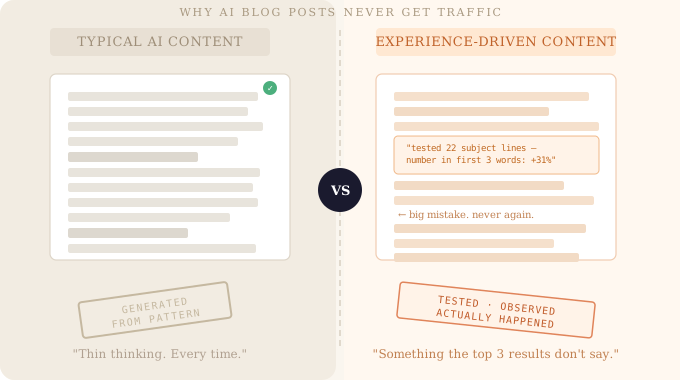
But those tools are generating from pattern. They’re producing what a page about this topic statistically looks like, based on everything they’ve trained on. Which means the output is, by definition, the average of what already exists.
Average content doesn’t rank. It competes directly against stronger, more established pages that covered the same ground first, better, with more authority.
(If you want the full list of patterns I’ve noticed, I covered the most common AI blogging mistakes in a separate post — some of them are genuinely embarrassing in hindsight.)
The Specificity Problem Nobody Wants to Admit
This is the one I keep coming back to.
The posts that rank — the ones I’ve written that actually get consistent search traffic — all have something in common. They say something specific. Not just accurate. Specific.
There’s a difference between “email open rates depend on your subject line” and “I tested 22 subject lines in one newsletter sequence, and the ones with a number in the first three words outperformed everything else by 31%. Didn’t matter what the number was. Just needed to be early.”
The first sentence is technically true. It’s also completely useless. I could generate that in two seconds.
The second sentence makes someone pause. It has a mechanism. It has a constraint. It feels like something a person learned by doing something.
AI tools almost never produce the second kind of sentence unprompted. They produce summaries of general knowledge, dressed up to look like insights.
Real Talk: Two Things I Got Completely Wrong
The first one. Early in my niche blogging, I published a 3,000-word AI-generated deep dive into a fairly specific topic — equipment reviews in a hobby niche. It looked great. Covered everything. Lots of subheadings, well organized, internally linked.
Six months later: 11 clicks total.
I went back and read it. Really read it. And I realized it said nothing that wasn’t already on the manufacturer’s website and three other review sites. It had length. It had zero perspective. Someone searching for that equipment didn’t learn anything from my post they couldn’t have gotten from the top result that already existed.
The second one. I thought updating AI posts would fix them. Just go back in, add a few more personal lines, tweak the intro. That’s it. That’s the fix.
Not even close. Sprinkling “I” statements into a structurally hollow post doesn’t make it valuable. It just makes it hollow with first-person pronouns. The search engines don’t care. More importantly, the actual reader doesn’t care — and bounce rate is a real signal.
Where It Usually Falls Apart (Be Honest With Yourself Here)
The prompting is too vague. Most people give AI tools a topic and a length. Maybe a keyword. That’s it. Then they’re surprised the output is generic.
If the prompt doesn’t include real constraints, real context, real opinions you want reflected — the output will be average by design. The tool is filling in blanks you left open.
The editing step gets skipped. This one is brutal. People publish the first draft. I’ve done it. We’ve all done it. But the difference between a post that ranks and a post that idles in index limbo is usually 45 minutes of actual editing where you ask “does this sentence say something real?”
The topic itself was too competitive. AI can help you write fast. It cannot help you compete against sites with 8 years of domain authority and 400 backlinks on that exact topic. If you’re targeting keywords with strong existing results and you’re a new site — AI-generated or not — you’re not going to rank. Full stop.
The content matches no real search intent. This is subtle but it kills a lot of posts. Someone optimizes for a keyword that technically exists but doesn’t map to anything a human would actually type into Google looking for help. The post gets impressions on weird variations, no clicks, bad CTR, and Google slowly stops showing it. Looks fine. Isn’t.
What Actually Works (Annoyingly Unsexy Version)
I want to be careful here because this is where everyone either gives up or oversimplifies.
AI isn’t useless for blogging. I use it regularly. But I use it for specific things: drafting structure, checking if I’ve missed a sub-topic, rewriting dense paragraphs into cleaner prose. What I don’t use it for is generating the ideas, the examples, the opinions, or the specificity.
Those have to come from me. From actual experience. From something I tested or noticed or got wrong.
The posts on my blogs that consistently bring in search traffic — and some of them have been in the top 5 for their keywords for over a year now — were all written with one filter: “Is there something in this post that the reader can’t get from the top 3 existing results?”
If I can’t answer yes to that, the post doesn’t go up.
That’s it. That’s the unsexy standard.
And almost no AI-generated post, as typically produced, passes that test without significant human intervention.
The question most people actually want answered — can AI blog posts rank at all — is yes, but the ones that do barely resemble what most people are publishing. There’s a real gap between “AI-assisted” and “AI-generated.”
The Honest Takeaway
The reason why AI blog posts never get traffic isn’t really about AI. It’s about the false belief that producing content and creating value are the same activity.
They’re not. They’ve never been. AI just made it possible to produce content at a scale that makes the gap between production and value more visible — because now you can publish a hundred posts that go nowhere instead of ten.
If you’re using AI as a research assistant, a drafting tool, a structure-checker — it can make your writing faster and sometimes better. If you’re using it as a replacement for having something to say, you’ll keep staring at zero-traffic dashboards wondering what went wrong.
The algorithm doesn’t hate AI content.
It’s just increasingly good at ignoring content that has nothing real to say.
And honestly? That seems fair.
If your AI posts are getting indexed but staying invisible, the fix is probably not publishing more. It’s making each post more specific, more useful, and more real — one post at a time. Start with your most recent piece. Read it like a stranger. Ask if it says anything the top 3 results don’t already cover better. If the answer is no, that’s your answer.
More about us
Hova Blogs is where we share real blogging tips, SEO experiments, AI content strategies, and honest lessons from what actually works online. No fluff. No recycled theory. Just practical stuff bloggers can use.
Explore more here: Hova Blogs
Join us on YouTube
We also share step-by-step blogging videos, SEO walkthroughs, and content growth strategies on our YouTube channel if you prefer watching instead of reading.
Watch here: HovaBlog YouTube Channel