
How Bloggers Use AI for Content (And Why Most of Them Are Still Doing It Wrong)
Okay so here is how this actually started for me.
I had been blogging for six years, and like most people in that position, I had opinions about how bloggers use AI for content. Mostly skeptical ones. I was doing everything manually — keyword research by hand, outlines in a Google Doc, writing every word myself. Quietly proud of it. Then a guy in my niche — personal finance, not a soft space — went from posting twice a month to posting almost every single week. Same quality. Still just him.
I figured he had hired someone. He had not.
He showed me his setup and I spent the next two months making a complete mess of it. Generated drafts that read like terms and conditions. Published two posts that went nowhere. Actually deleted one. The kind of thing you quietly remove and hope nobody noticed.
So when I say I tested this workflow — I mean I tested it badly before I tested it correctly. Most guides skip that part. This one will not.
So What Does “Bloggers Use AI for Content” Even Mean?
When people hear this, they picture someone typing “write me a post about email marketing” and clicking publish. That does happen. It is also why so much of the internet now reads like a Wikipedia article got into a car accident with a corporate newsletter.
What actually works is different. Very different.
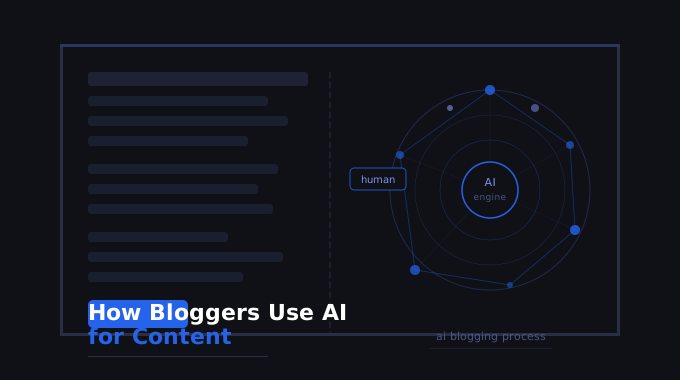
You handle the thinking — the angle, the opinion, the specific detail that only someone inside your niche would know. AI handles the scaffolding. The first rough pass at sentences you are going to rewrite anyway. Think of it less like a ghostwriter and more like a very fast typist who has read everything on the internet, has zero personal experience, and occasionally invents statistics with complete confidence.
That last part is not a joke. We will get to it.
Speed Is Not the Point. This Is.
Here is what I want to say before the workflow steps because people always miss it.
Publishing more does not automatically help you.
I watched a blogger in a cooking niche use this exact ai blogging process to go from four posts a month to twenty. Traffic went up slightly for three months. Then flatlined. The posts were thin. The topics were obvious. The whole thing felt like content generated to fill a calendar rather than actually help anyone.
Speed without judgment is just noise at scale. Full stop.
What fast SEO content creation actually gives you is the ability to execute faster on ideas that were already good. The good-idea part still requires you knowing your niche, knowing what your readers cannot figure out, knowing which searches are worth chasing and which are just crowded dead ends.
Google’s own helpful content guidance makes this distinction obvious — they are not rewarding volume, they are rewarding demonstrated experience and genuine usefulness. That does not change just because AI is involved in your drafting process.
AI is an accelerant. Not a compass. You still have to know where you are going.
Here’s the Process I Ended Up Keeping
This takes me about 15 to 20 minutes of real active thinking before I am in editing mode. People advertise 10 minutes. Sometimes it is 10. Usually not. Anyway.
Finding a topic — AI cannot do this for you
I use Ahrefs most of the time. Sometimes AlsoAsked when I want quick question phrasing. I start with a broad theme and look for real questions with real search volume that mid-size blogs are actually ranking for.
I let AI generate topic ideas twice early on. Both times I spent two weeks writing posts with almost no search demand behind them. Looked plausible. Did nothing. The problem is AI suggests whatever sounds reasonable based on patterns it has seen. It does not know your niche gaps, your audience frustrations, or the topic your competitors have somehow ignored for three years.
Topic selection is yours. Make it before you open any AI tool.
Keyword check — two minutes maximum
Paste the topic, look at difficulty and volume, check who is ranking. Big publications dominating page one means go narrower or go elsewhere. Smaller blogs near the top means you have a real shot.
I used to drag this out. Research spirals. Eleven tabs open. Now it is two minutes and a call. Done.
The outline — generate it, then actually fix it
Ask AI for a detailed H2 and H3 structure. You will have one in 30 seconds. And it will cover exactly what every other article on the topic already covers.
Competent. Obvious. Safe.
This is where most people go wrong. They take the AI outline, generate a draft on top of it, publish it, and wonder why it performs exactly like every other article. It performs like every other article because it is structured like every other article.
Edit the outline. Add the section missing from every competing post. Cut the two that are just padding. That is where the article becomes yours instead of a remix of everything already ranking.
Drafting — one section at a time, not the whole thing
I tried doing full-draft-in-one-prompt probably eight times before I stopped. The back half always falls apart. Always. It starts repeating the front half in different words. By the conclusion it is basically summarizing itself.
Painful. Every time.
One section at a time. Tell it the reader, the tone, the specific angle you want for that section. Specific prompts produce specific drafts. Vague prompts produce content that sounds like it is trying to satisfy every possible version of the topic simultaneously.
That is exactly what unhelpful content sounds like, by the way.
The Part Most People Rush — And Regret
Read the draft out loud. Not skimming. Actually out loud.
Every sentence that makes you flinch — the ones that sound like a webinar transcript or a LinkedIn post from a brand account — rewrite them.
I had one draft that used the phrase “in today’s fast-paced digital landscape” twice in the introduction alone. Twice. That was the moment I understood why this pass cannot be optional. AI defaults to the most statistically common phrasing for any idea, which means it defaults to the most forgettable version of every sentence it writes.
Looks fine. Isn’t.
Add the opinion. Add the small failure. Add what you actually think, not the diplomatic version that hedges everything. Generic content does not build readers. It fills pages for a while and then quietly stops ranking and sits there doing nothing.
This pass takes me 30 to 45 minutes on a 1500-word post. When I rush it below 20, the post shows it. Every time.
SEO — fast, not obsessive
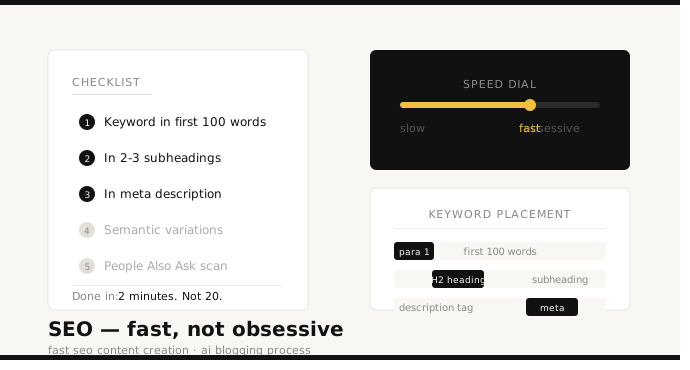
Primary keyword in the first 100 words, in two or three subheadings, in the meta description. Semantic variations woven in naturally throughout. If a sentence sounds jammed in, the section probably needs restructuring more than the keyword needs forcing.
Surfer SEO or NeuronWriter will tell you which related terms to include. Even just checking “People Also Ask” in Google for your keyword covers most of it for free.
Internal links — the thing I kept skipping
Every time I got into fast-publishing mode I forgot this. Every single time. And every time I went back a month later and added them, I was annoyed at myself for not doing it at publish.
Big mistake. Embarrassingly consistent one.
Paste a list of your existing posts into a prompt and ask for internal link suggestions with anchor text. Two minutes. Pick the two or three most natural fits. Add them. Move on.
Final check before publish
Title tag, meta description, featured image with alt text, clean URL slug, category, at least one internal link, one outbound link to something credible. Read the intro one more time.
If it does not pull you in, it will not pull anyone in. Fix it. Then publish.
The draft does not get better sitting in your CMS.
This Is Usually Where People Mess It Up
Trusting AI numbers. It fabricated a study once. Gave it a journal name, a year, an author. Looked completely real. I almost published it. Now I verify every stat that did not come from me personally.
Not ideal to learn that lesson post-publish. Learn it here instead.
Publishing the draft unedited. Did this twice. Those posts are still live and I wince every time Search Console shows me their zero impressions. They rank for nothing because they sound like nothing.
Using AI for topic ideas. Already said this. Two weeks, zero traffic, one deleted post. AI picks the obvious. You need the overlooked.
Full draft in one prompt. Back half collapses. Every time. I do not know why I kept trying. Section by section is the only method that holds.
So What Do You Actually Get Out of This?
Not a shortcut. I want to be straight about that.
What you actually get: less time in the painful slog of first drafts. Going from blank page to something editable in 15 to 20 minutes instead of two to three hours is a real advantage. What you do with that saved time is the entire question.
The bloggers genuinely winning with this are not doing less work. They are redirecting the work. Better research. More specific examples. Sharper editing. An extra humanization pass on the intro. The things that used to get skipped when they were already exhausted from just getting the draft down.
The ones using AI as permission to half-effort toward publish — those are the blogs you read once, close the tab, and never think about again.
You cannot name one right now. That is exactly the point.
More about us
Hova Blogs is where we share real blogging tips, SEO experiments, AI content strategies, and honest lessons from what actually works online. No fluff. No recycled theory. Just practical stuff bloggers can use.
Explore more here: Hova Blogs
Join us on YouTube
We also share step-by-step blogging videos, SEO walkthroughs, and content growth strategies on our YouTube channel if you prefer watching instead of reading.
Watch here: HovaBlog YouTube Channel