
Low Competition AI Blogging Niches That Still Get Traffic in 2026
I spent most of 2023 chasing the wrong thing.
I had three blogs. One on “AI tools for productivity,” one on “ChatGPT prompts,” and one generic AI news roundup site I built in a weekend because I thought I was being clever. You can probably guess how all three went. The productivity blog got crushed by bigger sites with actual domain authority. The prompts blog briefly hit some traffic, then Google’s helpful content updates essentially buried it. The news site — I don’t even want to talk about the news site.
The point is: I learned what low competition AI blogging niches actually means the hard way. Not from a course. Not from a YouTube video with a thumbnail of someone pointing at a number. From posting consistently for months, watching traffic graphs that looked like flat lines, and eventually figuring out why certain blogs in this space grow while most don’t even register.
Here’s what I actually know now.
What “Low Competition” Actually Means (and What People Get Wrong)
Most people interpret low competition as: nobody is writing about it yet.
That’s not quite right.
Low competition in AI blogging means the big players haven’t fully colonized it. There’s a difference. Some topics are low competition because nobody cares. Those you should avoid. Others are low competition because they’re too specific, too technical, or too niche for a general tech blog to bother with — but a real subset of people are actively searching for them.
That second category is where you want to live.
The mistake I kept making early on was picking topics with decent search volume but where Wired, TechCrunch, and three VC-backed content farms had already published definitive guides. Low keyword difficulty scores in SEO tools mean nothing when the top five results are from domains with a decade of backlinks behind them.
You don’t win that fight. Not starting out.
Why Most AI Bloggers Are Fishing in the Same Pond
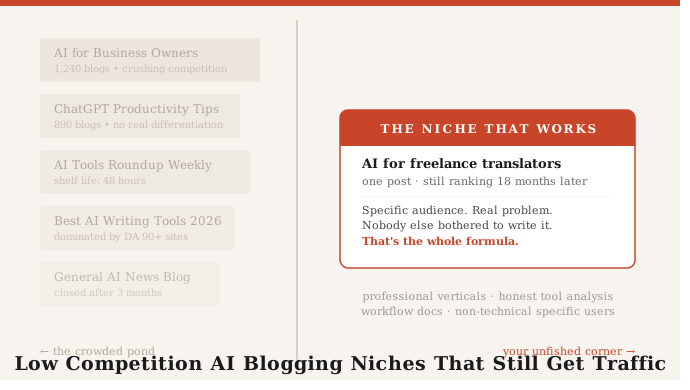
The obvious stuff is gone. “Best AI writing tools.” “ChatGPT vs. other AI.” “How to use AI for your business.” These were good niches in 2022. By 2024, every content site and their dog had published 4,000-word guides on them. By 2026, those spaces are genuinely overcrowded.
And here’s what’s frustrating: people keep entering them anyway. They use keyword tools, see “AI writing tools” has massive volume, and assume they can rank with a “better” article. They can’t. Not without serious domain authority or a very specific angle nobody’s taken.
The other error I see constantly is going after pure AI news content. That market is brutal. You’re competing with newsletters from people who’ve been doing this for years, plus every major tech outlet. News content also has a shelf life of about forty-eight hours. Big mistake building a traffic strategy on it.
What actually works in 2026 is the combination of: a real audience with a real problem, that the big sites consider too niche to bother with, where AI is genuinely part of the solution or the topic.
Let me walk through the niches I think fit that description right now.
The Niches That Are Actually Worth Your Time
Low Competition AI Blogging Niches in Professional Verticals
This is probably the most underexplored category, and also the one I wish I’d started with.
Think about it: every industry is scrambling to figure out how AI applies to their specific work. A general “AI for business” blog doesn’t help a structural engineer who wants to know if AI can help with load calculation review. It doesn’t help a speech-language pathologist figuring out if there’s a legitimate AI tool for therapy documentation that doesn’t create HIPAA nightmares.
Those people are searching. Specifically. And almost nobody is writing for them.
I stumbled onto this by accident when I wrote one post about AI tools for freelance translators — not a topic I planned, just something a friend asked me about. That post still pulls organic traffic eighteen months later. More than anything I wrote about “AI productivity” ever did.
The verticals I’d be looking at seriously: AI for trades workers (electricians, HVAC, estimating software), AI in specific legal practice areas (not “AI for lawyers” broadly — too broad — but something like AI for solo family law practitioners), AI for agricultural operations, AI for independent medical practices. These are audiences with money, with real problems, and with almost no one speaking directly to them.
AI Tool Tutorials for Non-Technical Users in Specific Contexts
Not “how to use ChatGPT.” Everyone has written that.
I mean something like: how a real estate agent uses Claude to draft disclosure documents. How a school librarian uses AI to help students with research without it doing their homework for them. How a personal trainer builds AI-assisted workout programming for clients with specific injury profiles.
The key is the specificity. “AI for teachers” is crowded. “How elementary school teachers use AI for differentiated reading instruction” is not.
I know someone running a small blog aimed specifically at nonprofit grant writers who use AI to draft funding applications. No grand strategy, no viral content. Just deeply specific, useful posts that answer the exact questions that specific audience has. She’s getting consistent traffic and email subscribers in a space where the big AI blogs would never bother to go.
That’s the model.
AI Ethics and Limitations Content — But Done Honestly
Here’s an opinion that might be unpopular: most AI ethics content online is either written by academics for academics, or by tech blogs that don’t actually take the concerns seriously. Both audiences are underserved by the other.
There’s a real gap for honest, readable content about where AI genuinely fails, what it actually gets wrong, and why that matters in practical contexts. Not think-pieces. Not doom-scrolling content. Practical, specific, honest analysis.
The interesting thing is that Google’s guidance around experience, expertise, authoritativeness, and trustworthiness consistently rewards content that shows real knowledge and doesn’t just cheerlead. An AI blog that says “here’s what this tool gets wrong, and here’s when you shouldn’t trust it” will often outperform one that’s just promotional. In my experience, anyway.
Embarrassing admission: I had an entire section on one of my blogs that was basically a list of AI tool benefits written in a tone that now makes me wince. It read like a press release. Zero personality, zero actual experience, zero acknowledgment that any of these tools have real limitations. Spent months trying to figure out why it wasn’t ranking. Should have been obvious.
AI Workflow Documentation for Specific Software Ecosystems
This is a sleeper niche that I think is significantly undervalued.
People who use specific software — accounting platforms, project management tools, CRM systems — are constantly figuring out how AI integrates with those tools. “How to use AI with [specific CRM]” type content. “Best AI plugins for [specific project tool].” Workflows combining existing software with new AI capabilities.
The audiences are targeted, the search intent is high-value, and the big AI content farms ignore it because it’s too platform-specific. A lot of the official documentation from software companies also doesn’t keep up with how users are actually using AI features in practice. That gap is real.
I’ve been doing a version of this on a small scale and it’s the most consistent traffic I see — not massive numbers, but genuinely targeted readers who are in a decision-making or learning mindset.
Where This Usually Falls Apart
Let me be direct about the failure modes.
Publishing too broadly. You pick a niche like “AI for healthcare” because the sub-niches feel too small. Then you’re competing against established health tech publications. The sub-niches feel small until you’re actually in them and realizing there are tens of thousands of people with that specific problem.
Treating AI topic blogs like regular blogs. The space moves fast. A tool-specific post can become outdated in months. This caught me off guard multiple times. I’d write a detailed tutorial about some AI feature, the tool would update, and suddenly the post was giving wrong information. You need a system for updating content, not just producing it.
Chasing traffic over trust. This one is harder to see while you’re in it. Early in my AI blogging I was obsessed with traffic numbers. What I should have been obsessed with was whether the people who found my content actually trusted it. Trust converts to email subscribers, to return visitors, to the kind of links you don’t have to ask for. Traffic without trust is a leaky bucket.
Writing about AI without actually using it. Genuinely painful to type, but I’ve seen it constantly — AI blogs written by people who are clearly summarizing other articles rather than having hands-on experience with the tools they’re covering. Readers can feel it, even if they can’t articulate why. It reads slightly hollow. The specificity isn’t there.
The Honest Takeaway
The low competition AI blogging niches that still work in 2026 aren’t secret. They’re just more specific, more unglamorous, and more demanding than most people want to deal with.
The bloggers who are actually building sustainable traffic are doing it by becoming the go-to resource for a very specific audience, not by trying to compete with TechCrunch on broad AI coverage. They’re going deep on professional verticals, on honest tool analysis, on workflow documentation for real humans doing real jobs.
You don’t need to be an AI researcher. You need to know a specific group of people well enough to write for them with actual authority.
Pick your niche. Stay in it. Write things that would embarrass you to publish if you hadn’t actually tested what you’re claiming.
Everything else is just noise.
Explore more here: Hova Blogs
Join us on YouTube
We also share step-by-step blogging videos, SEO walkthroughs, and content growth strategies on our YouTube channel if you prefer watching instead of reading.
Watch here: HovaBlog YouTube Channel