
Can AI Blog Posts Rank on Google in 2026? Here’s What I Found After Actually Testing It
Can AI blog posts rank on Google? I tested AI-assisted content across multiple websites and discovered what actually helps AI blog posts rank, what fails, and how Google evaluates AI-generated content in 2026.
Let me save you the twelve-paragraph preamble. Can AI blog posts rank on Google? Yes. Do most of them? No. And the gap between those two answers is where most people quietly lose months of effort without ever figuring out why.
I’ve been running content sites for a few years now. Started testing AI-assisted publishing properly about eighteen months ago across three different niches — a personal finance blog, a travel site, and a small software tools review site. Different audiences, different competition levels, different domain ages. Same experiment. I wanted to know what Google actually did with AI-generated content, not what the SEO forums said it would do.
The short version: Google doesn’t care that AI wrote it. What Google cares about — and this is the part that stings — is whether your article gives someone a reason to choose it over the ten things already ranking. And most AI content, used the way most beginners use it, doesn’t do that. At all.
What Google’s Stance Actually Means in Practice
Google’s official guidance on this hasn’t changed in any dramatic way. Their documentation on helpful content is consistent: they evaluate quality signals, helpfulness, and whether content serves humans rather than crawlers. They don’t penalise based on authorship method.
That’s not a green light. It’s more like a yellow light in heavy fog.
Here’s the part people miss: the Helpful Content system isn’t looking for an “AI wrote this” flag. It’s looking for signals that a piece of content exists to capture search traffic rather than genuinely inform a reader. And AI makes it extremely easy — almost effortless — to produce exactly that kind of content at scale. Content that checks every box on a surface level and means almost nothing underneath.
The YMYL categories — health, finance, legal — are genuinely stricter. Google’s E-E-A-T requirements in those spaces weight experience and trustworthiness more heavily. Publishing AI-generated financial advice without real expert input isn’t just an algorithmic risk. It’s an ethical problem. I’ve stayed out of those niches entirely with pure AI drafts. Not worth it.
Why Almost Everyone Gets This Backwards
Here’s the trap. You get access to an AI writing tool. You put in a keyword, a rough outline, maybe a tone instruction. Twenty minutes later you have a 2,000-word article. It looks professional. Clean headings. Logical flow. Good meta description. You publish it feeling like you’ve built something.
Six weeks later it’s sitting at position 56 with fourteen total impressions.
Big mistake. Not using AI — that part’s fine. The mistake is assuming that structure equals substance.
I made this exact error for about two months on my travel site. Published thirty-one posts in that window. Felt incredibly productive. Watched time-on-page crater. Watched bounce rate climb to around 81%. Watched rankings flatline across almost everything. The articles weren’t wrong. They were just hollow in a way that readers feel even when they can’t articulate it. They’d land, skim two paragraphs, leave. Nothing to hold them.
The content had no perspective. It had no real depth. It repeated what ten other articles already said — just in slightly shuffled sentences. Google had no reason to choose it over anything already ranking.
What stopped me was looking at the posts that were actually climbing — not just mine, but other sites in the niche. The ones gaining traction had something in common. Not better prompting. Not longer word counts. Someone who actually knew the topic was in the content somewhere. A specific observation. An actual number from a real experience. A “this didn’t work, here’s why” moment. Something that couldn’t have come from an AI reading the internet.
The Hybrid Workflow That’s Actually Producing Results
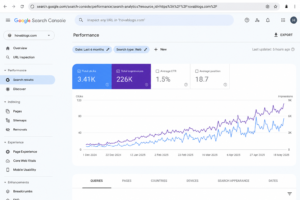
Across the three sites I’ve been running this experiment on, the pattern that keeps working is the same one that’s not very exciting to talk about: AI handles the scaffolding, a human handles the substance. The ratio shifts. Sometimes 70/30, sometimes closer to 50/50. The common thread is that someone with actual domain knowledge is deciding what the article says — not just how it says it.
What my current workflow looks like
I start by writing my key points manually. Not a bullet outline — actual rough sentences. What do I think about this topic that isn’t in the top five results? What have I seen that contradicts common advice? What specific data point or real example can I include that nobody else has? Usually three to five paragraphs of unpolished notes. That step takes maybe twenty minutes and it’s where everything useful in the article comes from.
Then I use AI to expand structure around those notes. Give it my points, give it context, ask it to format and fill in connective tissue. It’s genuinely good at that. It’s not good at generating the observations themselves. That’s not a bug — that’s just what it is.
Then I edit every paragraph for specificity. Read each section and ask: does this say something a decent Wikipedia summary couldn’t say? If not, I rewrite that section myself. This single step made a measurable difference. On three posts where I applied it back-to-back as a direct test, time on page went up noticeably. Scroll depth improved. Not dramatic numbers, but consistent — and consistency across three posts in a row is a signal, not a coincidence.
Specific Mistakes That Quietly Kill AI Post Rankings
I made most of these. Not hypothetically.
Publishing the draft without hunting for specificity. The AI version of any point is always the most general version of that point. That’s not a failure — it’s just what happens when something synthesises everything it’s seen rather than remembering a specific experience. You have to manually inject the specific example, the real number, the non-obvious observation. Every time you skip this, you publish something slightly worse than what’s already ranking. Painful. Every time.
Going after competitive keywords with no angle. If five authority sites already own a keyword with well-optimised, genuinely useful posts, your AI draft on the same topic is not moving them. You need a different sub-angle, a different audience frame, or a data point they don’t have. AI can’t generate that differentiation. That has to come from you knowing something they don’t know.
Publishing with no internal linking structure. This one sounds boring and it genuinely matters more than most people admit. I published fifteen posts on my travel blog without building internal linking strategy. All of them sat in the forties and fifties. When I went back and added contextual links from related posts with some traction already, four of those posts climbed into the top twenty within six weeks. Not joking. That direct.
A post with no internal links from related posts, on a site with no topical coherence, in a competitive space — it doesn’t exist in a content ecosystem. Google has no reason to trust it. The post is technically indexed and effectively invisible.
Writing on topics you have zero experience with. AI can write a technically accurate article about almost anything. It cannot give you the E-E-A-T signals — the Experience signals specifically — that Google is weighting more heavily in 2026. If you have no actual experience with the topic, the article will have no genuine observations in it. Readers feel that absence. They bounce faster. Engagement drops. Rankings follow. I learned this on my finance site. Every post where I couldn’t add anything from actual experience sat at the bottom. The ones where I had context — even just from one conversation with someone who worked in the space — performed differently.
Does Google Penalise AI Content Directly?
As of 2026: no confirmed blanket penalty for AI-detected content. Google’s own statements have been consistent — they’re evaluating quality signals, usefulness, and expertise. Not authorship method. That’s not going to change their fundamental position any time soon.
The risk isn’t detection. The risk is undifferentiated content in a competitive space. AI makes it very fast to scale that risk. But it’s a strategy problem, not an AI problem.
One nuance worth holding onto: Google watches engagement signals. Time on page, scroll depth, pogo-sticking back to the search results. If readers consistently land on your post and leave in thirty seconds, that’s a signal. It’s not the whole story, but it contributes. A technically clean article with 80% bounce rate is telling Google something. Over time, rankings reflect it.
Realistic Timeline: How Long Before AI-Assisted Posts Start Moving
New sites: plan for three to six months before seeing meaningful organic traffic, assuming consistent publishing and decent keyword targeting. Established sites with some domain authority see movement faster — sometimes weeks, on lower-competition keywords.
The timeline hasn’t dramatically changed from non-AI content. What AI changes is output volume. Whether more volume leads to faster results depends entirely on quality, not quantity.
I tested this directly. Spent one month publishing volume — eight posts in four weeks — using a process that wasn’t proven yet. Then spent the next month publishing two posts using the full workflow I described above. The two careful posts outperformed the eight fast posts within sixty days. Not ideal. Expensive lesson. Went back and had to repair all eight.
Volume is not the variable. Quality of insight is the variable. More content just means more posts sitting at position 47 if the insight isn’t there.
What I’d Actually Do Starting From Scratch Today
Pick a niche you genuinely know. Not sort-of know. Actually know. AI can manufacture structure. It cannot manufacture domain knowledge. The specificity of what you actually know is what determines whether your content has anything original to contribute.
Write your thinking first, then hand the draft to AI. Not the other way around. When you prompt AI first, you get the frame of an article without the substance of one. Looks fine. Isn’t.
Edit every paragraph for specificity before publishing. Read each section and ask whether it says something the reader couldn’t get from a ten-second Google summary. If not, rewrite that part yourself. This step is not optional if you want the posts to hold rankings long-term.
Watch engagement metrics, not just rankings. Bounce rate, time on page, scroll depth. If people are leaving in thirty seconds, no amount of optimisation work fixes that long-term. That’s a content problem, not an SEO problem. You can’t keyword your way out of content that doesn’t hold readers.
Don’t scale before you’ve found one version that actually works. Made this mistake twice. The cleanup is expensive in time and demoralising in a very specific way.
Quick Reference
| Question | Honest Answer |
|---|---|
| Can AI posts rank without human editing? | Technically yes. Practically unlikely on competitive keywords. |
| Does Google penalise AI-written content? | No confirmed blanket penalty. Quality signals matter, not authorship method. |
| Best use of AI for posts that rank? | Structure and drafting. The human provides depth, specificity, and real perspective. |
| How long to rank AI-assisted posts? | Same as any content: weeks to months depending on domain, competition, and quality. |
| Which niches are hardest for AI content? | Health, legal, financial. E-E-A-T requirements are stricter there. |
| Does volume help? | Not if quality isn’t proven first. More posts sitting at position 47 is just more noise. |
The content holding my top three rankings for over a year was all written when I had something real to say. AI helped me structure it. It didn’t write the part that made it worth reading. That part is still yours. It always has been — and no prompt is going to change that.
Explore more here: Hova Blogs
Join us on YouTube
We also share step-by-step blogging videos, SEO walkthroughs, and content growth strategies on our YouTube channel if you prefer watching instead of reading.
Watch here: HovaBlog YouTube Channel