

The SEO Mistakes I Didn’t Realize Were Hurting My Blog

I spent about eighteen months writing what I genuinely believed was good content. Consistent publishing schedule. Decent research. Real effort. And my traffic just… sat there. Barely moved. I kept blaming the niche, blaming the algorithm, blaming some vague idea that “it takes time.” What I wasn’t doing — what I refused to actually sit down and examine — was the SEO mistakes baked quietly into everything I was publishing.
Not the obvious stuff. Not “I forgot to add a meta description.” Deeper than that. Structural issues. Habitual assumptions. The kind of problems that don’t scream at you — they just slowly bleed your rankings until one day you realize a competitor with half your output is sitting at position two for every keyword you’ve been targeting for a year.
That’s not a fun moment.
Keyword Research Done Halfway
Here’s what I used to do: find a keyword with decent volume, check that the competition wasn’t insane, write the article. Done. Seemed logical. The problem is that’s only half the job, and honestly probably the less important half.
What I wasn’t doing was understanding search intent — what the person actually wants when they type that phrase. I’d target “best productivity apps” and write a roundup of ten tools. Reasonable. Except Google kept showing me that the top-ranking results for that keyword were all comparison articles with a very specific structure: two or three tools compared side-by-side with use-case breakdowns. My roundup format was wrong for the intent. Didn’t matter how well I wrote it.
Looked fine. Wasn’t.I also ignored what SEOs call “keyword modifiers” for an embarrassingly long time. Words like “free,” “for beginners,” “without X,” “2024.” I was writing generic articles for generic searches and then wondering why I wasn’t showing up for the specific searches people actually make. There’s a massive difference between someone searching “email marketing” and someone searching “email marketing for small business without a list.” One of those people is browsing. The other wants a specific answer right now.
Going into Google Search Console and looking at the actual queries people used to find my existing posts — then noticing how many of them included modifiers I’d never intentionally targeted. That list became my content calendar for three months.
Writing for Readers Who Don’t Exist
This one stings a bit to admit. I had a mental image of my ideal reader — thoughtful, patient, interested in nuance — and I wrote for that person. Long setup paragraphs. Careful context-setting. Gradual build to the main point. Journalistically structured.
The actual reader arriving from a Google search? They want the answer. They’re probably on their phone. They skimmed the headline, clicked, and within eight seconds they’ve decided whether to stay or hit back.
I was losing most of them in the first two paragraphs. My bounce rate was telling me this — I just wasn’t connecting the data to the behavior. When I finally started recording my own screen while re-reading my articles as if I were a stranger, it was uncomfortable. So much preamble. So much “in this article we’ll cover…” energy (yes, I did that, mortifying in retrospect). The answer the person came for was often buried three or four paragraphs in.
Big mistake. Repeated across dozens of posts.
“Google’s own documentation on helpful content emphasizes satisfying the user’s need. Not impressing them. Not showcasing your expertise for its own sake. Satisfying the need.”
That’s what changed how I structured everything. Front-load the value. Give people something in the first paragraph that makes them feel like they’re in the right place. Then go deeper.
The Heading Structure Disaster
I used headings wrong for a long time. Not obviously wrong — I wasn’t skipping H1s or anything that basic. The issue was subtler: my headings were decorative, not functional. They were breaking up walls of text rather than signaling actual structure.
Here’s what that looks like in practice. A post about “how to start a newsletter” where the subheadings are things like “Let’s Talk About Your Audience” and “Getting Into the Technical Side.” Those sound fine. They’re vague. Someone scanning the page can’t tell from those headings whether this article covers what they actually need to know.
Compare that to: “How to Choose Your Newsletter Platform (And Why It Matters More Than You Think)” — specific, answers a micro-question, tells the scanner exactly what they’re about to read. Totally different experience. And Google reads those headings. It uses them to understand what the section is about. Vague headings are essentially throwing away a structural signal.
I once published a 2,400-word post where every single subheading was a question phrased like a chat message — “So, What About Timing?” “Is Design Really That Important?” Felt conversational when I wrote it. In search results it read as thin and unfocused. Rewrote all the headings six months later and the page’s average position improved noticeably within a few weeks. Not scientific proof, but hard to ignore.
The other heading mistake: treating H3s as just “smaller H2s.” They’re not. H2s should be major sections. H3s should be specific points within those sections. When everything’s H2 or everything’s a mix with no logic, the page structure breaks down — for readers and crawlers both.
Internal Linking I Basically Ignored
Internal links are genuinely one of the easiest high-leverage things you can do for a blog, and I did almost none of it for the first year. Not intentionally ignoring it — just not thinking about it. Each post was a self-contained unit. I’d publish, move on to the next one.
The problem is twofold. One: Google discovers and re-crawls your content partly through internal links. An orphan page — something with no internal links pointing to it — can struggle to get crawled consistently. Two: internal links pass what’s called “link equity” between your own pages. When one of your posts earns backlinks from other sites, some of that authority can be distributed to related posts through your internal link structure. I was basically leaving that distribution to chance.
Not ideal. At all.When I did an internal linking audit — genuinely embarrassing how long that took me to do — I found posts that had zero internal links pointing to them. Posts I’d spent hours writing. Just floating there. I went through and added contextual links to around forty posts over a few weeks, and the crawl data in Search Console shifted noticeably afterward. More pages indexed, more pages showing impressions.
The anchor text of internal links matters. “Click here” tells Google nothing. “newsletter growth strategies” tells it exactly what the destination page is about. Specific anchor text, every time.
Publishing Speed Over Publishing Depth
This is probably the SEO mistake I’m still most annoyed at myself about, because the logic seemed sound at the time. “Post more, get more traffic.” It’s repeated everywhere. What nobody qualifies is: more of what?
I had a period where I was publishing three articles a week. Felt productive. My output graph looked great. But the articles were shallow. 900 words covering surface observations on topics where the top-ranking results were comprehensive 2,500-word guides with original research or genuinely unique angles.
Competing with a shallow 900-word post against a thorough, well-linked 2,800-word guide is like showing up to a knife fight with a spoon. You can post every day and still lose to someone who posts twice a month but goes deep.
The thing about Google that took me a while to really internalize: it’s not rewarding content that exists. It’s rewarding content that satisfies the searcher better than the alternatives. If the alternatives are genuinely better — more thorough, more specific, better structured — no amount of publishing frequency saves you.
Painful. Every time I looked at my analytics.I cut my publishing frequency from three a week to one a week, spent more time on each piece, started doing actual original observations and comparisons rather than just repackaging common knowledge — and the per-post performance went up meaningfully. Fewer posts, more traction. Counterintuitive until you understand what’s actually being evaluated.
Titles That Were Clever Instead of Clear
I have a slight fondness for wordplay. This is not an asset in SEO.
I used to write titles like “The Quiet Art of Getting People to Actually Read What You Write” when what I meant was “How to Write Blog Posts People Actually Finish Reading.” The first one sounds better, honestly. More editorial. The second one is what someone types into Google.
Title tags — what appears in the search result — are not the place for cleverness. They’re signaling. The person scanning ten results in four seconds is asking: does this match what I need? A clever title that doesn’t clearly answer that question loses the click to a boring title that does. Every time.
One of my posts sat at position six for a decent keyword for months. I rewrote the title tag to be more direct — added the exact phrase people were searching, moved the benefit to the front — and the click-through rate went up enough to push it to position four within a month. Same content. Same ranking position, roughly. Just more clicks because the title finally said what the article was actually about.
There’s also the meta description, which I was basically treating as an afterthought. Auto-generated snippets or one-sentence summaries that didn’t actually sell the click. Meta descriptions don’t directly affect rankings — Google’s been clear on that — but they absolutely affect whether someone clicks. It’s ad copy. Treat it like ad copy.
Chasing New Keywords While Old Posts Decayed
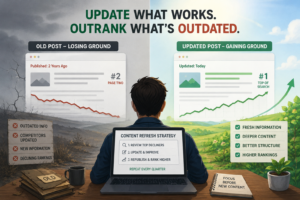
This took me genuinely too long to understand. Old posts don’t just maintain their position passively. Content ages. Competitors update their posts. New information emerges. Google’s understanding of what’s “fresh” and relevant shifts. And if you’re only ever writing new content without revisiting what already exists, you’re watching a slow leak you’re pretending isn’t there.
I had posts from two years ago that used to rank in the top five for their target keywords. By the time I checked, they’d drifted to page two. Not because Google suddenly disliked my site — because better, more updated content had outpaced mine. The fix wasn’t complicated: update the information, expand the depth, improve the structure, change the publish date. That kind of refresh often brings posts back. Sometimes past where they were before.
The specific pattern I now follow: every quarter I look at posts that used to perform well and have declined, and I pick the top five to refresh before writing anything new. It’s less exciting than launching new content. It works better, regularly.
Page Speed I Chose to Ignore
“My site feels fine when I load it.” That was my reasoning for years. Unscientific in a way that should embarrass any blogger who claims to care about SEO.
What I wasn’t accounting for: I’m usually on a fast connection. Often on desktop. My browser has the site cached. My experience of my own site is almost nothing like the experience of a first-time visitor on a mid-range Android phone on a 4G connection.
When I actually ran PageSpeed Insights — properly, in mobile mode — my scores were rough. Render-blocking scripts from plugins I barely used. Images not compressed. No lazy loading. A theme doing heavy lifting it didn’t need to. Core Web Vitals were a mess. Nothing catastrophic enough to get penalized directly, but enough friction to hurt user experience at the margins — and at the margins is where a lot of ranking decisions get made.
Fixed it. Took a weekend. Should have done it two years earlier.
What I’d Tell Someone Starting Now
Most SEO mistakes aren’t mysterious. They’re not algorithm secrets or technical edge cases only experts know about. They’re patterns of neglect, of optimizing for what feels productive instead of what actually moves rankings, of assuming effort in equals traffic out without examining whether the effort is aimed correctly.
I wasted probably eighteen months of real work because I was busy rather than strategic. Publishing without auditing. Writing without understanding intent. Building new content while old content quietly fell apart.
The good news — if you can call it that — is that none of these SEO mistakes are permanent. Old posts can be refreshed. Heading structures can be fixed. Titles can be rewritten in an afternoon. Internal links can be added retroactively. The damage is reversible. It’s just that you have to stop long enough to actually see it.
Most bloggers never do that audit. They keep publishing, keep hoping, keep telling themselves it takes time — and it does take time, but time working in the right direction. Not time spent confidently repeating the same errors at a consistent publishing cadence.
Traffic doesn’t reward the busiest blogger. It rewards the one who bothered to understand why their work wasn’t working.
Explore more here: Hova Blogs
Join us on YouTube
We also share step-by-step blogging videos, SEO walkthroughs, and content growth strategies on our YouTube channel if you prefer watching instead of reading.
Watch here: HovaBlog YouTube Channel