
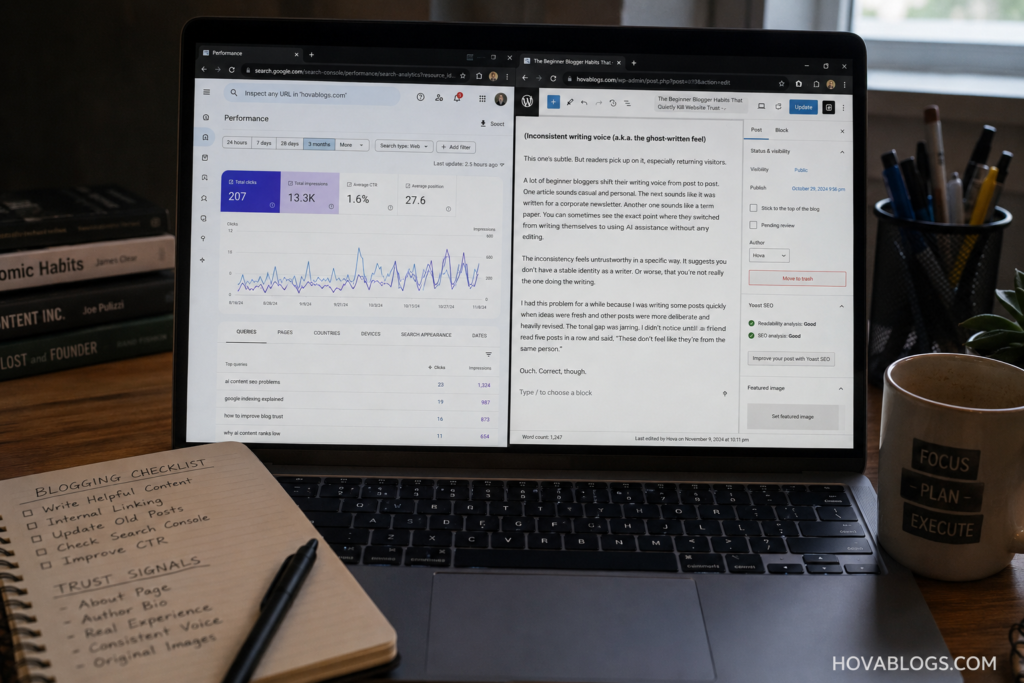
The Beginner Blogger Habits That Quietly Kill Website Trust
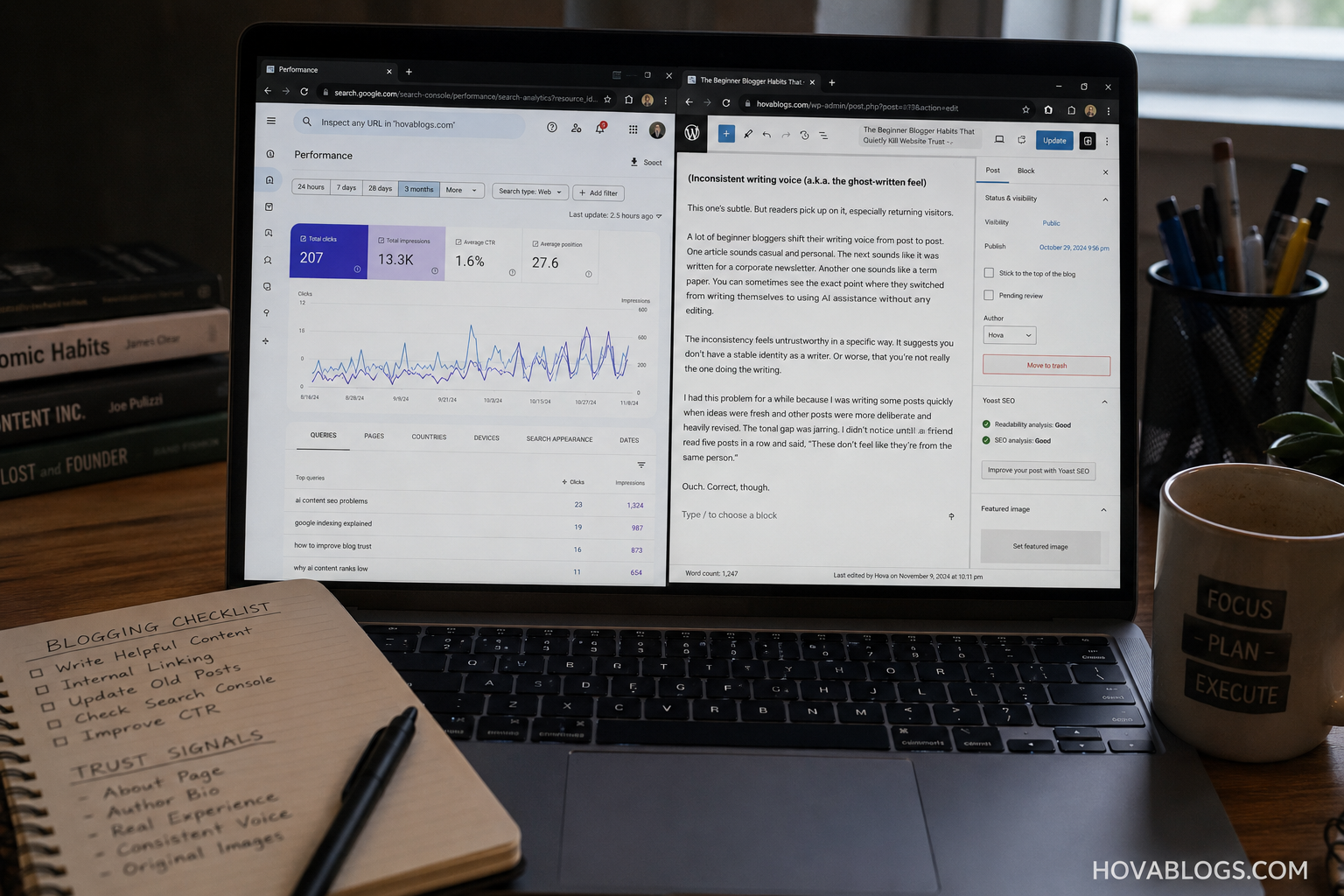
I spent the first eight months of blogging wondering why people kept bouncing off my site in under thirty seconds. Analytics were brutal. Decent traffic from Google, but engagement was basically nonexistent. No comments. No shares. Return visitor rate somewhere around four percent.
The problem wasn’t my content. Or at least, not only my content. It was the beginner blogger habits I’d built up without realizing — the invisible trust signals I was accidentally destroying every single week. Most of them felt harmless. Some even felt like the “right” thing to do. Turns out, readers are more perceptive than we give them credit for. They don’t consciously list reasons why a site feels off. They just leave.
What “trust” actually means for a blog (and what it doesn’t)
Everyone talks about E-E-A-T these days. Google’s been beating that drum for years. But trust on a blog isn’t just about SEO signals or having credentials. It’s something more immediate and visceral — the feeling a reader gets in the first ten seconds of landing on your page.
Does this person know what they’re talking about?
Are they trying to help me, or sell me something?
Does this site feel like a real human made it?
Those questions happen fast. Unconsciously. And a surprising number of beginner blogger habits are specifically calibrated to answer those questions wrong.
Trust isn’t a checkbox. It’s a cumulative impression. And it erodes in small ways.
Why most beginners get this badly wrong
Because they learned blogging from other bloggers who were also getting it wrong.
There’s a whole ecosystem of “how to start a blog” content out there, and a distressing amount of it teaches habits that made sense in 2014 and quietly stopped working. Exact-match anchor text. Keyword stuffing in headings. Publishing ten posts in a week and then going silent for a month. Copying the structure of big media sites onto a personal blog that has zero editorial authority yet.
The other problem is that beginners learn from metrics that don’t tell the full story. Traffic goes up, so they assume what they’re doing is working. But traffic and trust are different things. You can rank for a keyword and still leave every reader feeling vaguely skeptical of your site. Those readers never come back. Never share. Never recommend you.
I learned this the hard way after getting a piece to page one and watching it get basically zero backlinks, ever. It ranked. People found it. They read it. And then they… nothing. Because the piece read like it was assembled from bullet points scraped off Reddit, not written by someone who’d actually done the thing.
The actual habits that are killing your credibility
The generic author bio problem
This one sounds small. It isn’t.
Most beginner blogs have one of two author bio setups: a completely empty one (genuinely terrifying from a trust perspective) or something like “John is a passionate writer who loves sharing tips about [niche].”
Passionate writer. Loves sharing tips. Every single blog uses these words. I used them.
They communicate nothing. Worse, they feel like placeholders — like you didn’t think it mattered. And readers do notice, even if they can’t articulate why.
The specificity gap is real. Compare “passionate writer who loves sharing tips about personal finance” with “I paid off $40,000 in student loans in three years while making $52,000 a year. Here’s what actually worked.” Second one earns trust immediately. First one reads like a template.
Took me embarrassingly long to fix mine.
Publishing frequency lies
There’s this pressure in blogging communities to publish consistently. Three times a week. Every Tuesday. Never miss a schedule.
The problem is that beginner bloggers often can’t sustain that without cutting corners on quality. So they publish something thin — a 600-word piece that’s basically a listicle of things you could find in five minutes on Google — just to hit their arbitrary posting schedule.
That post sits on your site forever. Every new reader who hits it forms an impression.
I had one of these. An article about productivity tools that was basically a shallow overview of things like Notion and Todoist with no actual insight. It got some traffic from long-tail keywords. And I watched through Hotjar recordings as people spent about 45 seconds on it and left. The bounce rate was 91%.
Not ideal.
The article was signaling something to every visitor: this blogger doesn’t go very deep. And that signal bleeds into how readers perceive everything else on your site.
Stock photo overload
Look, I get why beginners use stock photos. You don’t have original images yet. You’re not a photographer. Canva exists.
But there’s a specific type of stock photo that destroys trust faster than almost anything else: the posed business/lifestyle image. You know the ones. Smiling woman with laptop in coffee shop. Hands typing on keyboard in golden hour light. Man pointing at whiteboard.
Those images signal “content farm.” They’ve become so associated with low-quality clickbait content that readers have developed a kind of unconscious aversion to them.
I noticed this when I compared session data between posts with original screenshots versus posts with stock imagery. Posts with my own messy screenshots — even blurry, inconsistently sized ones — had significantly better scroll depth. Readers stayed longer. The screenshots felt real. They suggested that I had actually opened the software and done the thing.
Your original, imperfect images are worth ten times more than perfect stock photography.
The about page graveyard
Most beginner “About” pages follow an identical template: here’s when I started the blog, here are some fun facts about me (I like coffee!), here’s my mission to help people.
It’s the most wasted real estate on most blogs. Nobody cares when you started your blog. They care whether you’re going to help them.
The About page is one of the highest-converting pages on any content site — if it’s written right. It’s where skeptical readers go to decide whether to trust you. And beginner bloggers almost universally treat it as an afterthought.
Wrote mine in about twenty minutes when I launched. Didn’t rewrite it for seven months. By the time I actually looked at the traffic data, it was getting significant visits from people coming through from posts — and the page had a 95% exit rate. They came, they read my generic paragraph about loving coffee and helping people live better lives, and they left.
Painful. Every time I think about it.
Linking to nothing and everything at random
Internal linking done badly is almost worse than no internal linking at all.
Beginners learn that internal linking is good for SEO, so they jam links into their content without thinking about whether the links are useful to the reader. Or they go the opposite direction and add no internal links whatsoever because it feels weird linking to yourself.
Both approaches tank trust in different ways.
Random linking — especially with lazy anchor text like “click here” or “read this post” — signals that you don’t really understand why linking matters. It reads as an SEO tick rather than a genuine attempt to help the reader find more useful content.
No linking signals that you’re operating in isolation. That your posts are islands. That you haven’t thought about your reader’s journey at all.
The right approach is so obvious once you understand it: link when it genuinely helps the reader go deeper on something they’re already curious about. That’s it. Not for SEO. For the reader. The SEO benefits are a downstream effect of useful linking, not the goal.
Inconsistent writing voice (a.k.a. the ghost-written feel)
This one’s subtle. But readers pick up on it, especially returning visitors.
A lot of beginner bloggers shift their writing voice from post to post. One article sounds casual and personal. The next sounds like it was written for a corporate newsletter. Another one sounds like a term paper. You can sometimes see the exact point where they switched from writing themselves to using AI assistance without any editing.
The inconsistency feels untrustworthy in a specific way. It suggests you don’t have a stable identity as a writer. Or worse, that you’re not really the one doing the writing.
I had this problem for a while because I was writing some posts quickly when ideas were fresh and other posts were more deliberate and heavily revised. The tonal gap was jarring. I didn’t notice until a friend read five posts in a row and said, “These don’t feel like they’re from the same person.”
Ouch. Correct, though.
Where it all usually falls apart
The most common point of failure is the first three months.
You launch with good intentions. You write a few solid, genuine pieces. Then you start consuming more blogging advice, and the advice starts to influence your behavior in ways that pull you away from your natural voice and toward some imagined “professional blogger” persona.
You start writing more formally. You start hedging every opinion. You start adding disclaimers everywhere. You start trying to rank every post for keywords instead of just writing things that are worth reading.
The personality drains out of the writing. The trust signals start collapsing. And you’re left with something that looks like a blog but reads like a content machine.
Google has written at length about rewarding content that demonstrates real experience and genuine helpfulness. That’s not an SEO checklist. It’s a description of what readers have always wanted: someone who’s been there, knows the territory, and is talking to you like a real person.
The moment you start writing for an abstract “audience” instead of a specific person, you lose something you can’t easily get back.
What to actually do about it
Go back and audit your oldest posts. Not for SEO. For trust. Read them like a stranger would. Ask: does this feel like a real person wrote this? Does this feel like someone who’s done the thing? Or does it feel like a content summary?
Fix your author bio. Be specific to the point of awkwardness. Credentials matter, but demonstrated experience matters more.
Kill your worst posts. Not every thin article is worth rewriting. Some should just disappear. A smaller archive of trustworthy content is better than a large archive of mediocre content.
Stop publishing on a schedule if the schedule is making you cut corners. Readers would rather wait two weeks for something real than get something shallow every Tuesday.
Use your own images when you possibly can. Screenshots, photos you’ve taken, diagrams you’ve drawn. Imperfect is fine.
The truth about beginner blogger habits is that most of them feel like shortcuts but function as trust traps. They look like productivity. They feel like progress. But every thin post, every generic bio, every stock photo of a smiling laptop user is slowly, quietly telling your readers: you don’t need to take this seriously.
And they’re listening.