
Most AI Blog Posts Aren’t Bad — They’re Just Empty
Most AI blog posts are technically optimized — but still feel hollow. Here’s why readers stop trusting AI-written content, and what actually makes blog posts feel real.
There’s a specific feeling you get when you’re reading an AI blog post and something’s just… off. You can’t always name it immediately. The information is fine. The structure is clean. The keyword is in the title, the subheadings are spaced correctly, the meta description is tidy. And yet two paragraphs in, you feel nothing. You’re skimming. You don’t trust it.
That feeling has a name: emptiness. And it’s the defining problem with most AI blog posts right now — not that they’re wrong, not that they’re badly formatted, but that they feel hollow in a way readers register instantly even when they can’t explain why.
I’ve published this kind of content. That’s the embarrassing part. Early on I genuinely thought “optimized” meant a checklist. Title. Keyword density. Subheadings. Internal links. Done. I thought I was being efficient. What I was actually doing was producing content that Google crawled, ranked briefly, then quietly deprioritized while better blogs ate my traffic. Took me longer than I’d like to admit to understand what was actually missing.
What “SEO Optimized” Actually Means vs. What People Think It Means
Here’s the confusion. Most people treat SEO optimization like it’s a formatting exercise. Put the keyword here, use this word count, add an FAQ section. That’s not wrong, exactly — but it’s table stakes. It’s not the thing that makes content perform.
Google has been pretty explicit about this, actually. Their helpful content guidance keeps hammering on one idea: content should be made for people, not for search engines. “Does the content provide original information, reporting, research, or analysis?” That’s a direct question from their own documentation. Not “does it have the keyword in the H1.” Not “is it 1,800 words.”
Most AI blog posts answer the first set of questions fine. They bomb the second one completely.
Because here’s what actually makes a blog post work in the long run: someone reading it and feeling like they got something they couldn’t find anywhere else. A real angle. A specific insight. Something that doesn’t sound like it was assembled from the five top-ranking articles on the same topic.
That’s a high bar. AI tools, by design, remix what already exists. They’re not going to have an opinion. They’re not going to tell you the thing they tried that flopped. They’re going to give you a confident, complete-sounding answer that says approximately what every other article on the subject says.
Looks fine. Isn’t.
Why AI Blog Posts Feel Empty (Even When They’re Long)
This one took me a while to put words to, because it’s subtle. It’s not bad grammar. It’s not obviously wrong information. It’s something more like… the absence of a person.
Real writing has friction. A real writer gets slightly annoyed mid-article. They’ll contradict themselves two paragraphs in and then catch it. They’ll mention a detail that’s so specific it could only come from actually doing the thing. “I tested this on a Shopify store that was doing about 400 sessions a month, not a big site, and the results were—” that kind of thing.
AI blog posts don’t have that. They have coverage. Every angle is addressed. Every objection is answered. It reads like someone checked off a list of “things this article should include.”
And that’s precisely what makes it feel empty. It’s complete in a way no real person writing from experience is ever quite complete. Real experience is jagged. You know some parts really well and other parts you kind of glossed over because you’re not sure. That comes through in writing, and readers trust it.
I once published a 2,400-word piece on email list building. Comprehensive. Genuinely. Hit all the points. Got maybe 40 organic visitors in three months and a bounce rate north of 85%. Then I wrote a 900-word post about one specific thing I did wrong with my welcome sequence — one mistake, one fix, what I noticed — and it still gets shares. The shorter, messier, more specific one won. Every time. Painful, honestly.
The Specific Ways AI Blog Posts Give Themselves Away
Not to make this a roast, but here are the actual patterns I keep seeing:
The confident opener that says nothing. “In the ever-evolving landscape of digital marketing, content remains king.” Nobody said that and meant it. It’s throat-clearing dressed as insight.
The list that explains itself too much. “Here are five strategies to improve your content: 1. Write high-quality content. High-quality content is important because…” Yes. Thank you. I know why quality matters. Skip to the part where you tell me what that actually looks like in practice.
Transitions that announce themselves. “Now that we’ve covered X, let’s move on to Y.” That’s a textbook move. Real writers don’t stop to narrate the structure. They just go.
The balanced non-opinion. You ask a real question — “is long-form content still worth it?” — and the article spends 600 words carefully presenting both sides and concludes with something like “it depends on your goals.” Thanks. Useless. Big waste of time.
No failure, anywhere. This is the big one. Read a hundred AI blog posts and count the failures. You won’t find many. Real subject matter experts fail constantly. They write about it because it’s where the actual learning happens. AI tools skip that part because they don’t have it.
What Actually Makes a Blog Post Feel Human and Real
I’m going to be blunt about this: there’s no shortcut to authenticity. Which I realize is annoying to hear if you’re trying to scale content production. But it’s true.
What works — what actually builds an audience that comes back — is specificity layered on top of experience.
Specificity means: not “test different headlines” but “I tested seven headline variations on this one post over six weeks and the one that used a number in brackets outperformed everything else by 40%, which surprised me because I thought I’d hate that format.” That level of detail. That kind of slight self-contradiction.
Experience means: you’ve actually done the thing. Or you’ve talked to someone who has, in enough depth that you can channel their specific knowledge rather than their general awareness.
When I write from experience, my drafts are messier. They’ve got asides. They’ve got “actually, scratch that” moments. I’ll say something definitive and then walk it back slightly two sentences later. That’s not weak writing. That’s how thinking people communicate.
Here’s a micro-thing I’ve noticed: the best blog posts usually have at least one sentence that sounds like it came from a very specific frustrating Tuesday. You can’t manufacture that. You can kind of fake it if you’re skilled. But readers feel the difference, even if they can’t articulate it.
Where AI Blog Posts Usually Fall Apart (Even When They Start Okay)
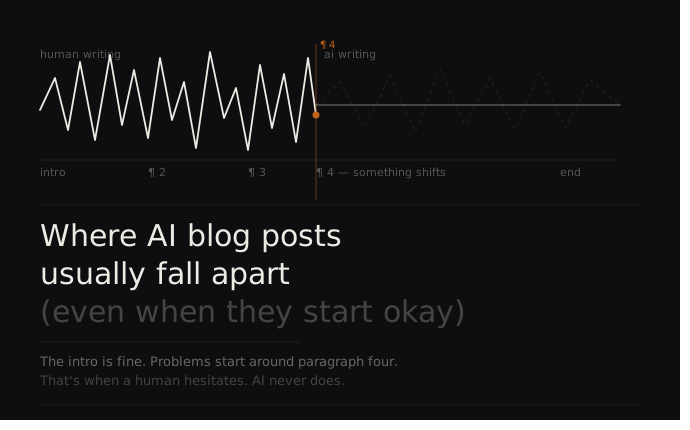
The intro is often fine. Because the intro is high-level and confident-sounding content is easy to generate convincingly. Problems start around paragraph four or five.
That’s when a human writer would get into the nuance, the exceptions, the “but here’s the thing nobody mentions” section. Instead, AI blog posts flatten out. They keep the same tone, the same sentence rhythm, the same level of confidence throughout. It’s oddly frictionless. Reading it feels like listening to someone who never hesitates.
Nobody never hesitates. That’s the tell.
I’ve also noticed that AI blog posts handle counterarguments badly. They’ll address an obvious objection in a way that’s technically correct but misses the emotional weight of why people actually have that objection. It’s like someone who read about an experience versus someone who lived it.
And the endings. God. “By implementing these strategies, you’ll be well on your way to achieving your content goals.” I’ve written that sentence. I’m not proud of it. It says nothing, commits to nothing, and leaves the reader with nothing.
The Honest Takeaway
None of this means AI tools are useless for blog content. I use them. Research, outlines, first-draft structure when I’m stuck — fine. Useful. The mistake is treating the output as finished work.
The mistake is outsourcing the part that actually matters: the perspective, the experience, the specific failures, the blunt opinions, the moments where you sound like a real person who has actually tried this and has something to say about it.
SEO is increasingly a game of patience and trust. Google’s gotten better, slowly, at detecting what readers already know intuitively: whether a piece of content was written by someone who knows what they’re talking about, or whether it was assembled from the parts of things written by people who did.
You can optimize all the metadata you want. If the post is hollow, it will feel hollow. And readers will leave. And eventually, rankings will follow.
The content that actually builds something — an audience, a reputation, search equity that compounds over time — is the stuff that sounds like a person sat down and wrote it because they had something to say.
Not because they had a keyword to rank for.
There’s a difference. Readers know it. Start writing like you do too.
Explore more here: Hova Blogs
Join us on YouTube
We also share step-by-step blogging videos, SEO walkthroughs, and content growth strategies on our YouTube channel if you prefer watching instead of reading.
Watch here: HovaBlog YouTube Channel