
I Publish a Blog Post Every Day. Here’s the Exact AI Content Strategy 2026 Workflow I Use (Takes 10 Minutes)
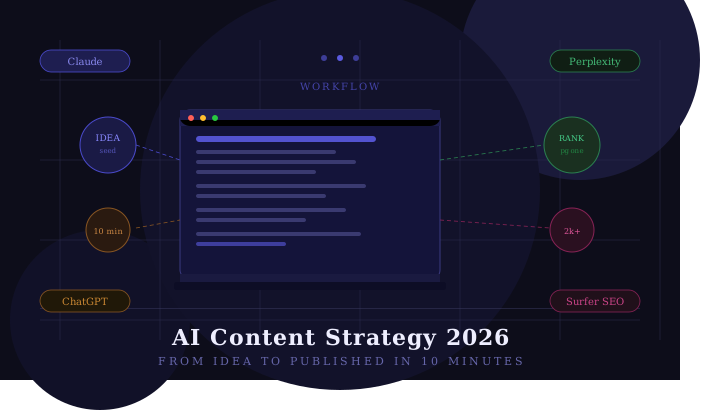
AI content strategy 2026 Last Tuesday, I published a 1,400-word article at 7:14 AM. I had started writing at 7:04 AM.
No, it was not garbage. It ranked on page one of Google within 11 days. Over 2,000 people read it in the first week.
I am not telling you this to brag. I am telling you because I want you to understand that this is not a productivity hack or a “work smarter not harder” motivational post. This is a repeatable system that I have tested, broken, fixed, and refined over nine months of daily publishing.
And the entire thing runs on an AI content strategy 2026 that most bloggers are not using yet.
If you are still spending three hours per post, opening a blank Google Doc and just staring at it, or publishing once a month because you never have time — this is for you.
What “AI Blogging Workflow” Actually Means (Not What Most People Think)
Let me be honest about something first. When most people hear “AI blogging,” they think: open ChatGPT, type “write me a blog post about X,” copy and paste.
That does not work. It produces content that reads like a Wikipedia article written by a robot who has never met a human being. Readers bounce. Google ignores it.
A real AI blogging workflow is different. It means using AI tools at specific, targeted moments in your process — and you staying in control of the parts that actually require a human brain.
Here is the honest breakdown. AI is excellent at:
- Generating outlines and structure
- Expanding bullet points into rough paragraphs
- Suggesting related subtopics and keywords
- Summarizing research from multiple sources
- Checking for readability and flow
AI is terrible at:
- Coming up with genuinely original angles
- Writing introductions that hook real people
- Adding personality or humor that lands
- Making judgment calls about what your specific audience cares about
Your job in this workflow is to handle the parts AI is bad at — and let it carry the parts it is good at. AI content strategy 2026
That is the whole system.
Why Your Current AI Content Strategy 2026 Is Probably Leaving Money on the Table
Here is a question worth asking: are you using AI to create content, or are you using AI as a glorified search engine?
Most bloggers I talk to are doing the latter. They ask AI for ideas, get a generic list, pick one, open a doc, and then write everything themselves anyway. They are getting 10% of the time savings they could be getting.
The bloggers who are winning right now — the ones with growing traffic, consistent publishing schedules, and posts that actually rank — have built what I call a “three-layer system.” It looks like this:
Layer 1: AI handles structure and scaffolding Layer 2: You handle voice, argument, and unique insight Layer 3: AI handles polish, SEO review, and formatting
When you separate the work this way, writing stops feeling like work and starts feeling like editing. And editing is ten times faster than writing from scratch.
This approach to AI content strategy 2026 is not about publishing more mediocre posts. It is about publishing better posts more often, without the burnout that kills most blogging projects within six months.
The Exact 10-Minute Workflow: Tool by Tool, Step by Step
I am going to be specific here. Not vague. I will tell you which tools, which prompts, and what output to expect.
Step 1: Nail the Idea in 60 Seconds
Tool: ChatGPT-4o or Claude
Before anything else, I write one sentence that answers this: “What is the specific problem this post solves, and for whom?”
Then I run this prompt:
“I want to write a blog post for beginner bloggers about [topic]. Give me 5 specific, search-intent-driven angles I haven’t seen before. Not generic. Think about what someone types into Google at 11pm when they’re frustrated.”
The key phrase there is “frustrated.” It forces the AI to think about real emotional pain points, not textbook definitions. The output is usually two or three angles you would never have thought of yourself.
I pick the one that feels most specific and most under-served. That takes about 60 seconds total.
Step 2: Build an Outline That Is Actually Good (2 minutes)
Tool: Claude
Most AI-generated outlines are boring. Introduction, What Is It, Why It Matters, Tips, Conclusion. Boilerplate.
Here is the prompt I use instead:
“Write a detailed blog post outline for: [your title]. Structure it like a narrative, not a listicle. Each section should build on the last. Include one ‘myth-busting’ section, one ‘step-by-step’ section, and end with something the reader can do in the next 10 minutes. Target reader: [describe your audience].”
This gives you an outline with momentum. Readers do not click away because they are bored — they click away because nothing is pulling them to the next section. A narrative structure fixes that.
I usually make two or three edits to the outline before moving on. Maybe I reorder a section, or I add a personal story I know fits in a certain spot. Takes two minutes.
Step 3: Rapid Research (90 seconds)
Tool: Perplexity AI
Perplexity is the most underrated research tool in this workflow. Unlike ChatGPT, it pulls real, sourced, current information from the web and shows you exactly where it came from.
I type in my main topic and ask:
“What are the most surprising or counterintuitive findings about [topic] from the last 12 months? Give me data, stats, or expert quotes with sources.”
I skim the results. I pick two or three specific facts that I can actually verify — I click the source links and confirm they are accurate. This takes ninety seconds because I am not doing deep research. I am finding credibility anchors.
- AI content strategy 2026
One good stat in a post does more work than ten vague claims.
Step 4: Write the Draft (3 minutes)
Tool: Claude
I paste my outline and run this prompt section by section:
“Write the [section name] section of this blog post. Tone: like a smart friend explaining something over coffee — direct, a little opinionated, no corporate-speak. Length: 150-200 words. Include this specific point: [add your personal insight or the stat you found]. Do not use phrases like ‘In today’s digital landscape’ or ‘It’s important to note.'”
That last instruction matters more than you think. AI defaults to certain filler phrases constantly. Blocking them out forces it to write more naturally. AI content strategy 2026
I do this for each section. The output is a rough draft — usable, but not done.
Step 5: Add Your Voice (2 minutes)
This is the step most people skip. It is also the most important one.
I read every paragraph out loud. Anything I would not actually say to a person gets rewritten. Anything that sounds like a textbook gets deleted or simplified. Any place where I have a real opinion, a real experience, or a real example — I add it.
This is where the post goes from “good enough” to actually useful. This step does not need AI. It needs you. Your readers are following you, not your tools. AI content strategy
Step 6: SEO Check and Formatting (1 minute)
Tool: Surfer SEO or NeuronWriter (free tier works)
I paste the draft in, check that my primary keyword appears naturally in the title, first paragraph, one or two H2s, and the conclusion. I check that I am not keyword-stuffing. I look at the content score and fix any glaring gaps.
Then: short paragraphs, H2s and H3s where they belong, a clear meta description, and publish.
Total time from blank page: 10 minutes, 30 seconds on a slow day.
Sub-Topics You Also Need in Your AI Content Strategy 2026
A strong AI content strategy 2026 is not just about individual posts. Here is what the full picture looks like:
AI for content repurposing: Once a post is published, I paste it into Claude and ask it to generate a Twitter thread, a LinkedIn post, and three short-form video scripts. One piece of content becomes five. This is where the real leverage is.
AI for internal linking: I maintain a simple spreadsheet of all my published posts. When I finish a new draft, I paste the list into Claude and ask: “Which of these posts are most relevant to link from within this new article?” It identifies connections I would miss and saves ten minutes of manual cross-referencing.
AI for keyword clustering: I paste a list of 20-30 keyword ideas into Claude and ask it to group them by search intent. This helps me build proper content clusters instead of a random pile of disconnected posts.
AI for headline testing: Before I finalize any title, I run this prompt: “Give me 10 alternative headlines for this post. Make five of them curiosity-driven and five of them benefit-driven. Flag which ones you think would perform best in search.” I usually end up combining elements from two or three options.
Tips From Nine Months of Daily Publishing
Build your prompt library before you need it. I keep a Notion doc with every prompt that has worked well. When I sit down to write, I am not figuring out prompts from scratch — I am copy-pasting from my own tested playbook.
Use AI for the boring stuff, never the important stuff. Conclusions, hooks, and personal stories should always come from you. These are the things readers remember. Everything else is fair game.
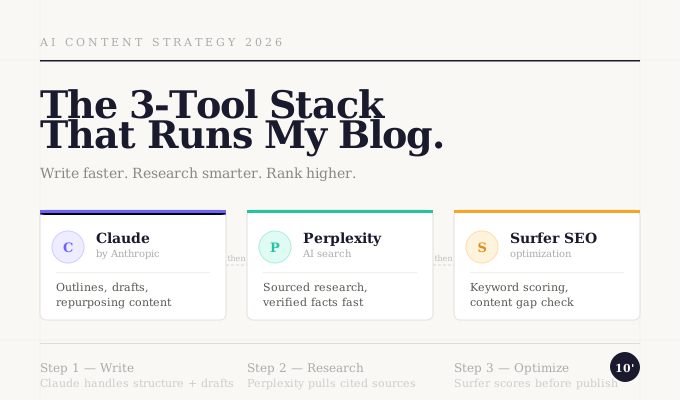
Do not use the same AI tool for everything. My current stack: Claude for writing and outlining (it follows instructions better than most), Perplexity for research, Surfer for SEO. Different tools, different strengths.
Publish first, perfect later. The biggest mistake new bloggers make is not publishing imperfect posts. A post that goes live at a 7.5 out of 10 will always beat a post that never leaves your drafts folder.
Common Mistakes That Are Killing Your AI Blog Strategy
Mistake 1: Using AI output as final copy. You will always know more about your audience than your AI tool does. The draft is a starting point, not a destination.
Mistake 2: Writing for AI instead of for people. Keyword stuffing, unnatural phrasing, robotic sentence structure — these hurt your rankings and your reader experience. Write for the human first. The algorithm rewards that.
Mistake 3: Skipping the research step. Opinions without evidence are just opinions. One well-sourced stat turns a decent post into a trustworthy resource. People share resources. They do not share opinions.
Mistake 4: No content cluster strategy. Individual posts are weak. A cluster of 10 posts all linking to each other around a core topic is strong. Your AI content strategy 2026 should be building clusters, not random articles.
Mistake 5: Treating every post the same. Some posts need 800 words. Some need 2,500. AI can help you figure out which is which — paste your title into Claude and ask what length would best serve the search intent behind that keyword.
Conclusion: The 10 Minutes That Change Everything
Here is the thing about a workflow like this. The first time you run through it, it will take you 20 minutes. The tenth time, you will be at 12. By the thirtieth post, 10 minutes is normal.
The compounding effect of consistent publishing is real. An AI content strategy 2026 that gets you to publish twice a week instead of twice a month means 100 more posts per year. That is 100 more chances to rank, 100 more chances to be found, 100 more chances to build the kind of audience that actually does something when you publish.
You do not need to write faster. You need a better system.
Now you have one. Go use it.